
A custom vs template website decision hides a question: which part of the work do you actually need done? A template saves some of it. A custom design saves a different part. Start with what your customer needs to do, then buy the scope that fits how your business wins work.
A template can carry excellent writing and a sensible inquiry path. A custom design can carry six paragraphs saying very little, arranged with tremendous confidence. I would compare the work before the screenshots.
At The Quiet Protocol, you do not need a large design budget to get an agency-built website. Our Essential Website is $99/month for hosting and care, free design and build. Our agency writes and builds up to ten essential pages from your business information, selects suitable images and creates a clear contact route. Your care plan includes SSL and support with changes.
When the business needs original positioning, conversion copy and a connected inquiry or booking path, I recommend a Smart Website, from $2,395 setup + $197/month. We design the customer journey and implement the next step, so you are buying more than a set of attractive screens.
A template saves some work. Which work?
A template gives you a starting arrangement: places for headings, photographs, navigation and content. Squarespace's current 7.1 templates share features and style options. Choosing one does not confine you to its example content or layout. Wix also offers templates alongside its editing and hosting tools. These are platform capabilities, not a promise that someone has worked out your service offer. Squarespace getting started, Wix plans
Imagine a fictional owner-operated painting company. It offers interior painting within a defined area. The owner has good photographs, can explain how estimates work and answers inquiries reliably. A modest site using a well-chosen template may do the job beautifully. The business does not need a software monument to explain that someone will visit, look at the rooms and prepare an estimate.
Now imagine a fictional advisory firm with several services, different eligibility rules and inquiries that need different reviewers. The starting layout is a small part of its problem. Someone must help visitors choose the right service, explain the limits and arrange a useful next step.
That thinking can happen inside a template. Custom thinking matters more than custom decoration.
What are the two proposals actually buying?
A scope sheet for the same business. Ask each builder to fill in the missing work, regardless of platform.
- Starting layout
- A licensed template, an adapted design or an original design. Identify which and what can be changed.
- Words and evidence
- Who writes the service explanation, selects real photographs and checks the claims? Supplied by you and written for you are different scopes.
- Customer path
- What must a visitor understand before calling, requesting an estimate or booking? Who designs that path?
- After submission
- Where does the inquiry go, who replies and what happens if that person is away?
- After launch
- Who owns the accounts, makes ordinary edits and checks that forms still work?
Compare completed responsibilities. A lower quote may be perfectly fair because you are supplying more of the work.
| Purchase | What you get | What you still do |
|---|---|---|
| Template, self-built | Layout and tools | Words, photos, connections, upkeep |
| Done-for-you professional site | A clear presence, written and cared for | Approve and update content |
| Custom site with a connected inquiry path | Positioning, copy, design and the path behind the form | Approve rules and review results |
Pay for the part your business is missing
If the service explanation is already clear and the next step is simple, keep the scope focused. Our Essential Website turns the business information you supply into a professionally designed, responsive presence, with essential on-page search setup. The design and build are free. Your monthly payment covers fast hosting, SSL, ongoing website care and support with changes. You get the finished work and someone to contact afterward.
Buy deeper work when the visitor has a harder decision: several service routes, substantial evidence to weigh, or an inquiry that must reach a particular person. That is where our connected website packages earn their price. We work out the service choices, write the explanation, create the custom design and configure the agreed customer path. A Conversion Website adds guided multi-service intake; an Authority Website gives expertise and proof the space they need.
Be precise about the word “custom.” It could mean choosing your colours, drawing every screen from scratch, connecting an existing form to your records, or writing a new application. These are different jobs. Ask what becomes possible because of the extra work. If the answer is only “it will feel more premium,” ask to see the customer problem that premium treatment solves.
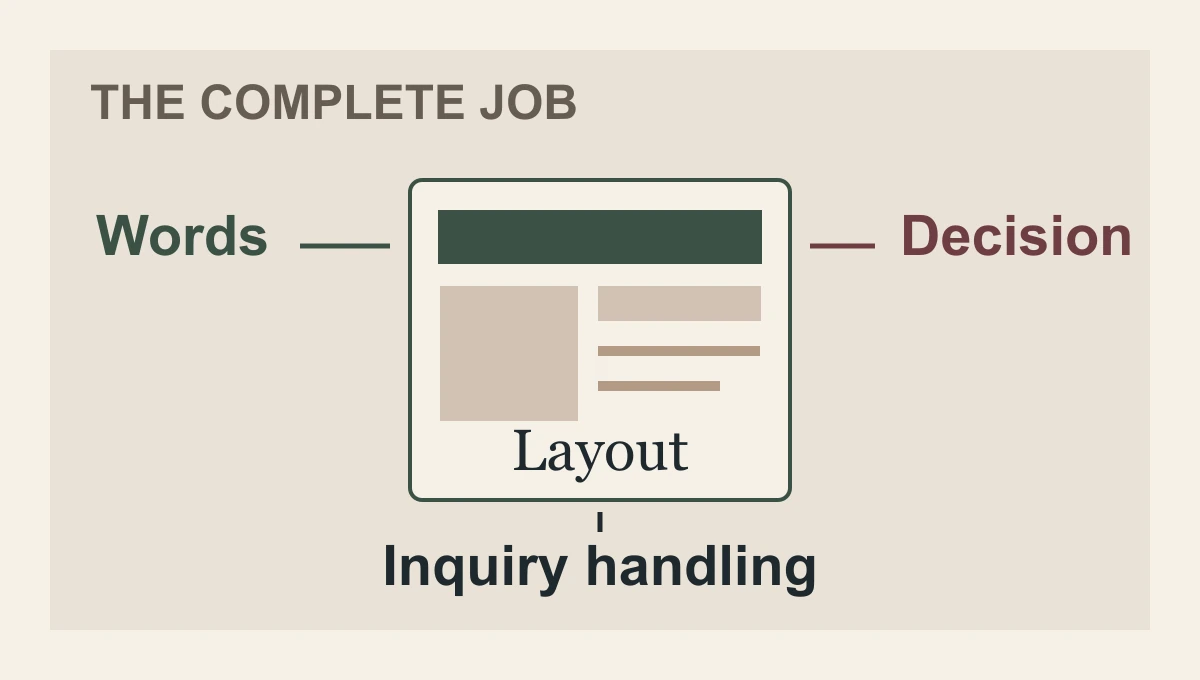
The expensive site can still leave you writing everything
Watch for a proposal that promises bespoke design but asks you to supply all copy, proof and service structure. That may be a legitimate design engagement. It is not the same purchase as a finished website that helps a new customer decide.
Likewise, a low-cost template package may include careful writing and a complete inquiry setup. Its use of a template does not make that work less useful.
Name the deliverable beside the price. For example: “Write three distinct service pages from approved interviews and supplied evidence” tells you more than “SEO-ready copy.” “Submit a test inquiry and confirm the responsible person can reply with its context” tells you more than “contact form included.”
W3C's forms guidance covers labels, instructions and feedback. Those basics apply whatever the design method. Google asks whether content is useful and original; drawing a homepage from scratch does not answer that question. Neither a template nor a custom design comes with a ranking guarantee. W3C forms tutorial, Google's helpful-content guidance
Leave room for the person who will look after it
A beautiful site that requires the original designer to change every sentence has created an ongoing dependency. Sometimes that is acceptable. It should be an informed choice.
Before approving either proposal, ask the person who will maintain the site to change a service sentence, replace a photograph and find a test inquiry in a demonstration. Include template licences, platform subscriptions, paid add-ons, writing, migration, training and ongoing support in the comparison. Obtain the actual local quote; “template” and “custom” are not standard price categories.
Buy a complete customer path, with the important thinking included. For a clear professional presence with no upfront design bill, choose our Essential Website. For a website that must explain fit and carry the visitor into a useful inquiry or booking, choose our Smart Website packages.
Bring the service you want to sell and the next step your customer should take. We will build the design, words and connection around that job. That is a more useful investment than paying for originality nobody can explain.
Frequently asked questions
Is a template website enough for a small business?
A clear, accurate site can be a sensible starting point. The important question is which work the business still needs: positioning, distinctive design, service explanation or a connected inquiry and booking path.
Does custom design automatically create more customers?
No. Design needs to support a useful decision and a working next step. Check the actual customer route rather than treating a custom layout as a conversion result.
Why choose a TQP website instead of buying design alone?
We design the visitor path and the work behind it together. Start with the Essential Website when the business needs a clear foundation; choose a connected Smart Website and systems when inquiries, booking and follow-up need to become one working path.
Essential includes free agency design and setup, with a monthly hosting and care plan. Compare Smart Website packages when you need a connected inquiry, booking or handoff.
Choose a website built around your customer’s next step