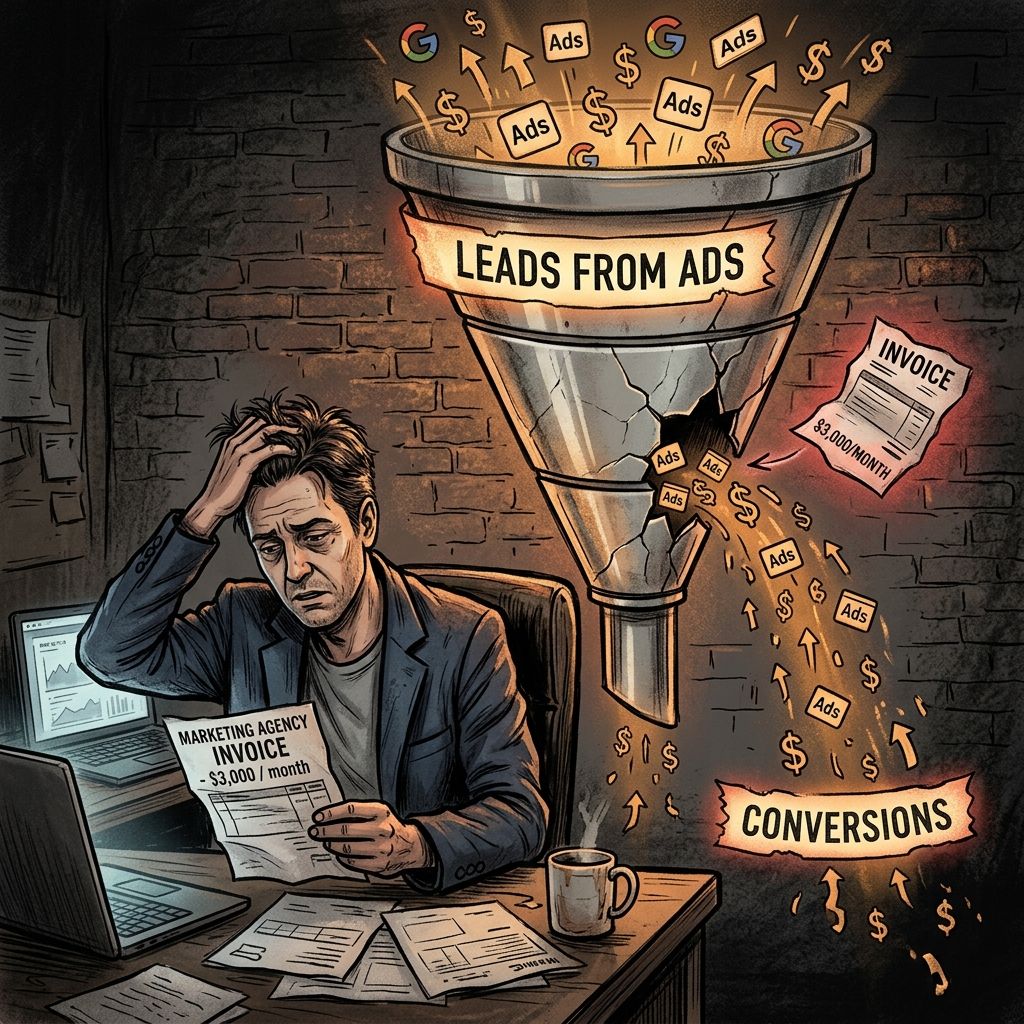
Before buying more leads, diagnose missed calls, slow follow-up, weak booking, CRM gaps, review proof, and conversion leaks in the sales path.
This article links to 3 external sources beside the claims they support.
# Why Your Marketing Isn't Working, And It's Probably Not the Marketing's Fault
If you've spent $3,000 or more a month on Google Ads and you're thinking about firing your agency ,
Wait.
Read this first.
I'm not saying your agency is doing great work. Maybe they're not. But before you move your budget to the next vendor who promises better CPCs and lower cost per lead, there's a question you need to answer honestly:
What actually happens to a lead after it arrives?
If you can't answer that with specific data, timestamps, response times, conversion rates by channel, then firing your agency is the wrong move. You might be firing the only part of the system that's working.
The Call I Get More Than Any Other
I get calls from business owners who have fired three marketing agencies in four years.
They say the same thing: *"Nothing works. We've tried everything."* Facebook Ads, Google Ads, SEO, direct mail, a new website, a rebrand. Thousands of dollars. Months of effort. The needle barely moved.
Then I pull their call logs and their form submission records. And we find the same thing every time.
The leads were arriving.
A physiotherapy clinic in Vancouver was getting 28 - 35 Google Ads clicks per week on high-intent keywords. Average CPC was $7.40. Their agency was doing reasonable work, not perfect, but competent. The leads existed.
Eleven of those 35 weekly clicks were converting to some form of contact attempt: a call, a form fill, a direct message. Eleven leads per week. The owner thought they were getting two or three.
Of those eleven: four were calls that went to voicemail. Two were form submissions that sat in an email inbox for 14 - 22 hours before anyone responded. One was a direct message that nobody saw for three days.
The clinic was booking three new patients a week from their ads, a number that felt underwhelming given the spend.
They were actually *losing* seven leads a week that they didn't know existed.
At an average patient lifetime value of $1,400, that's $9,800 in potential revenue disappearing every week. Not because the ads were bad. Because nobody was home when the leads knocked.
The Assumption That's Bankrupting Your Ad Budget
Here's the belief that gets owners into trouble:
> *More spend → more leads → more revenue.*
The logic seems airtight. Spend more, reach more people, get more calls, book more jobs. If that's not happening, the spend must be wrong. Or the targeting. Or the creative. So you fire the agency and try a new one with fresher ideas.
But this model skips the most important variable:the conversion environment the lead enters when it arrives.
Marketing creates interest. Your intake system, the phones, the response time, the follow-up, the booking process, converts that interest into revenue. If your intake system is broken, no amount of ad spend fixes it. You're just generating more leads to lose.
I've worked with businesses that were converting 8% of their inbound leads into booked appointments. After fixing their intake, not their ads, conversion went to 24%. Same budget. Triple the bookings.
Their agency got the credit. They didn't deserve it. The agency had nothing to do with it.
How to Diagnose What's Actually Happening to Your Leads
Before you make any decisions about your marketing, you need to answer four questions. These take about 20 minutes to work out if you have access to your call logs and CRM.
Question 1: How many leads actually arrived last month?
Not bookings. Not conversions. Raw leads, calls, form fills, DMs, chat messages, any contact attempt from a prospect who didn't yet have an appointment.
Most business owners underestimate this number significantly. They feel what's been booked, not what was attempted.
Question 2: What happened to each lead within the first 5 minutes?
This one stings.
Research fromHarvard Business Review on speed-to-leadfound that companies contacting leads within one hour are seven times more likely to have a meaningful conversation than those who wait even sixty minutes. Wait 24 hours? You're 60 times less likely to reach them.
Sixty times.
Every hour you wait after a lead arrives, its probability of converting drops dramatically. And in most service businesses I audit, the average response time to a form submission is somewhere between four and twenty-two hours. Some go unanswered entirely.
Question 3: What's your after-hours call handling?
BrightLocal dataconsistently shows that the majority of consumers research service providers in the evening. This makes intuitive sense, they're at work during the day. They're looking for a dentist, a plumber, or a physio at 8pm.
Your office is closed at 8pm.
What happens to those calls? If the answer is "voicemail," you're not capturing them. Voicemail conversion rates are, in my experience, somewhere between 10% and 20% for service businesses, and that's optimistic. Most people who reach voicemail just call the next result on the page.
Question 4: What's the drop-off between lead and booked appointment?
This is the conversion gap. Every business has one. The question is how big yours is and where the leakage is happening, at first contact, at scheduling, at the confirmation stage, or somewhere in between.
Work through these four questions with real data. What you find will almost certainly change where you direct your energy next.
The Speed-to-Lead Problem Is Worse Than You Think
I want to spend more time on question two, because it's the most consistently broken piece I find in audits, and it's the one owners are most surprised by.
TheInsideSales / Xant researchon lead response time has been replicated dozens of times across industries. The finding is consistent: response time is the single biggest controllable variable in lead conversion.
Not your pitch. Not your price. Not your reviews. How fast you respond.
A lead that gets a response in under two minutes converts at a rate 5 - 8 times higher than one that waits two hours. This isn't a marginal difference. It's the difference between a growing practice and a stagnant one.
Here's why service businesses struggle with this structurally:
Your best people, the ones who actually understand the business and can handle a lead well, are your clinicians, your technicians, your stylists. They're occupied with the very service you're selling. They can't respond to a web form in two minutes. It's physically impossible.
So the lead goes to a front desk coordinator who's already on the phone, scheduling another patient, handling a payment, and answering a question from a colleague. The form fill notification sits in an email inbox. The timing passes. The lead books elsewhere.
This is not a staffing problem. It's an architecture problem. And the solution isn't hiring more front desk staff, it's building a system where first contact happens automatically, immediately, regardless of what your team is doing.
'Your Next Agency Won't Fix This, But Your Intake System Might'
I say this clearly to every business owner who comes to me after firing a marketing agency.
The agency was probably generating leads at an acceptable cost. The problem was downstream of the agency's work. And the next agency will generate leads at a similar cost, which will also disappear into the same broken intake process.
You can spend $5,000 a month on Google Ads. You can have the most optimized campaign structure, the best Quality Scores, the most precise geo-targeting. If a real person calls at 7:45pm and reaches a voicemail that nobody checks until 9am, you've spent that money to generate a lead for your competitor.
They'll answer their phone. Or they have a system that does.
What a Fixed Intake System Actually Looks Like
The physiotherapy clinic in Vancouver I mentioned earlier, once we diagnosed what was happening to their leads, the fix was surprisingly focused.
We implemented three changes:
1. Immediate first response via SMS for all form fills.
Within 60 seconds of a form submission, the prospect received a text message: personalized, short, from the clinic's number, acknowledging their inquiry and asking a simple question to start the conversation. Not a confirmation email. A text. Conversion from form fill to booked appointment went from 18% to 41%.
2. AI-assisted after-hours call handling.
Calls received after 6pm and before 8am were answered by a voice AI that could capture the prospect's name, reason for inquiry, and preferred callback time, and could answer common questions about services, insurance, and availability. Prospects who were ready to book immediately could be offered a link to self-schedule. The clinic recovered roughly 60% of after-hours leads that previously went to voicemail.
3. A lead follow-up sequence for non-responders.
Any lead that didn't convert in the first 24 hours received a structured two-touch follow-up: a second text at 24 hours, a call attempt at 48 hours. This alone recovered about 15% of leads that had previously been written off as cold.
Three changes. No new ad spend. No new agency.
Monthly new patient bookings increased by 34% in 90 days.
The agency, who they had been on the verge of firing, got a new budget increase.
How to Calculate What Broken Intake Is Costing You Right Now
This is the exercise I run in every Revenue Leak Diagnostic, and you can do a rough version of it yourself in ten minutes.
Take last month's ad spend. Divide by the number of leads that arrived (calls + forms + DMs). That's your cost per lead.
Now take your number of booked appointments and divide by total leads. That's your conversion rate.
For most service businesses I audit, the conversion rate is somewhere between 15% and 30%. For businesses with good intake systems, I see 40 - 60%.
The gap between those numbers, at your cost per lead, is your waste.
If you're spending $4,000 a month on ads, generating 80 leads, and converting 20 of them, your conversion rate is 25%. If a fixed intake system brought that to 45%, you'd be booking 36 appointments from the same 80 leads. Same budget. Sixteen extra bookings.
At $1,200 average lifetime value per new customer, that's $19,200 in additional revenue from the same ad spend.
That's not a marketing ROI problem. That's an intake ROI problem.
A Word About What This Actually Requires
I want to be direct about something, because it comes up in every audit.
Fixing your intake system requires a willingness to change how your business operates at the front door. That means technology, but it also means process changes, staff buy-in, and occasionally a conversation with people who've been answering phones the same way for eight years.
The technology is the easy part. I can deploy a voice AI and an automated SMS follow-up sequence in a week. Getting a front desk team to trust a new system and integrate it into their workflow takes longer.
This is not a reason not to do it. It's a reason to treat it as an operational project, not a tech install.
The businesses that see the biggest results from intake fixes are the ones where the owner is personally committed to the change, not just delegating it and hoping it happens.
FAQ: The Skeptical Questions I Actually Get
"So is this just an ad for your product?"
Honest answer: partly, yes. I build these systems for service businesses. That's what The Quiet Protocol does.
But here's what I'd say to the skeptical version of you: the diagnostic is free. The math I've described above, the four questions, the cost per lead calculation, the conversion gap estimate, you can do all of that yourself without spending a dollar with me. And if the numbers don't reveal a significant intake problem, then yes, maybe it is the marketing.
I genuinely recommend that you run the numbers before you decide anything. If the data shows your intake conversion is already at 50%, go fire your agency.
"We have a great receptionist. We don't need AI to answer our phones."
You probably do have a great receptionist. That's not the point.
Your receptionist works 8 hours a day, five days a week. Leads arrive 24 hours a day, seven days a week. Your receptionist can handle one call at a time. During busy periods, multiple leads call simultaneously. Even a great receptionist in a busy practice will miss calls, return them late, and occasionally fail to follow up.
This isn't a criticism of your staff. It's math. A system handles volume and timing; a person handles nuance and relationship. The best intake combines both.
"We're not a tech company. Our customers want to talk to a human."
Yes, and they will. A well-designed intake system doesn't replace human contact. It accelerates the path to it.
When a prospect fills out a form at 9pm and gets a text response within 60 seconds that says "Hi, this is Sarah from [clinic], thanks for reaching out. Are mornings or afternoons better for your first appointment?", that prospect doesn't know or care whether Sarah is a person or an AI. They know someone responded immediately. They feel valued. They book.
The human relationship is built in the appointment. The system just makes sure the appointment happens.
"We've already tried automations and they felt robotic and off-brand."
This is a real failure mode and I don't want to dismiss it. I've seen businesses implement badly configured automations that sent generic, corporate-sounding messages at 3am and alienated more leads than they converted.
The difference is in the implementation: message tone, timing, personalization tokens, and a clear pathway to a real person when needed. Poorly built automations feel robotic. Well-built ones feel like a responsive business.
"What if we fix the intake and the marketing really is the problem?"
Then at least you'll know. Right now, if you fire your agency without running the numbers, you're guessing. Fix the intake first, it's faster and cheaper than a new agency engagement, and then look at your lead data with clean inputs. If leads are arriving and converting at industry-standard rates and revenue still isn't growing, then yes, it's time to look hard at your marketing strategy.
But in 200+ audits, I have found broken intake in over 80% of businesses. I have found genuinely broken marketing in fewer than 20%. Start with the more likely problem.
The Move That Changes Everything
The owner who fires three agencies in four years is not a bad businessperson. They're usually a skilled operator who's deeply good at the actual service they provide. They just have a blind spot: they assume the revenue problem lives in the department labeled "marketing" because that's where the spend is.
The spend is visible. The invisible drop-off between lead arrival and booked appointment is not.
Once you make the invisible visible, once you pull the call logs and the form data and run the numbers, the solution usually becomes obvious. And it's almost never "spend more on ads."
It's almost always: answer faster, follow up more consistently, and don't let leads die after business hours.
That's a system problem. And system problems have system solutions.
Want to know exactly what your leads are costing you to lose?
Run the Revenue Leak Diagnostic, enter your monthly ad spend, lead volume, and conversion rate, and it will estimate your annual revenue leak in under two minutes. Orbook a Revenue Leak Diagnosticand I'll pull your actual call data and show you the math live.
Either way, know the number before you make your next move.
The loss estimate is basic business math, not a magic claim.
Revenue-leak examples on this site are built from visible operating inputs: inquiry volume, missed-call or slow-response rate, booking rate, average job or client value, repeat value, and follow-up recovery. The fastest way to make the number real is to run the diagnostic for your closest business type, then compare it against your own call log, CRM, booking calendar, form timestamps, and review activity.
Review the trust signals visible before someone decides to call.
The useful question is not only the star rating. It is whether recent proof supports the promise the website makes.

Vikram Roy is the founder of The Quiet Protocol, a Toronto-based systems firm serving service businesses across the Greater Toronto Area, Canada, and the United States. He works directly with professional firms, home service companies, dental practices, clinics, and local businesses to connect websites, customer intake, booking, reviews, follow-up, and practical AI into a clearer digital front door. All content is written from Toronto, Ontario. See the editorial method →
Inspect review recency, response habits, and the public trust signals buyers see before they contact the business.
See how the capability in this article fits into a complete customer journey.
Service BusinessesSee the same decision through the language, buyer behavior, and operating reality of this industry.
Client Results & ProofInspect the starting condition, installation, measurement window, and outcome behind real client work.

The Real Cost of a Missed Call for a Service Business: The Math Nobody Runs
A missed call costs more than the immediate job. Here is the full three-layer calculation, immediate value, lifetime client value, and referral chain, and the annual total most owners never see.

What Is a Revenue Leak Diagnostic? The 15-Minute Diagnostic That Reveals Your Service Business Revenue Gap
A Revenue Leak Diagnostic is a structured 15-minute diagnostic that calculates the exact dollar value of revenue a service business is losing at the point of first contact, before a single dollar of marketing is changed.

The Service Business Lead Leak Diagnostic: 10 Questions That Reveal Where Your Leads Are Going
Most service businesses are not losing leads to competitors. They are losing them at the front door. This 10-question diagnostic shows you exactly where.