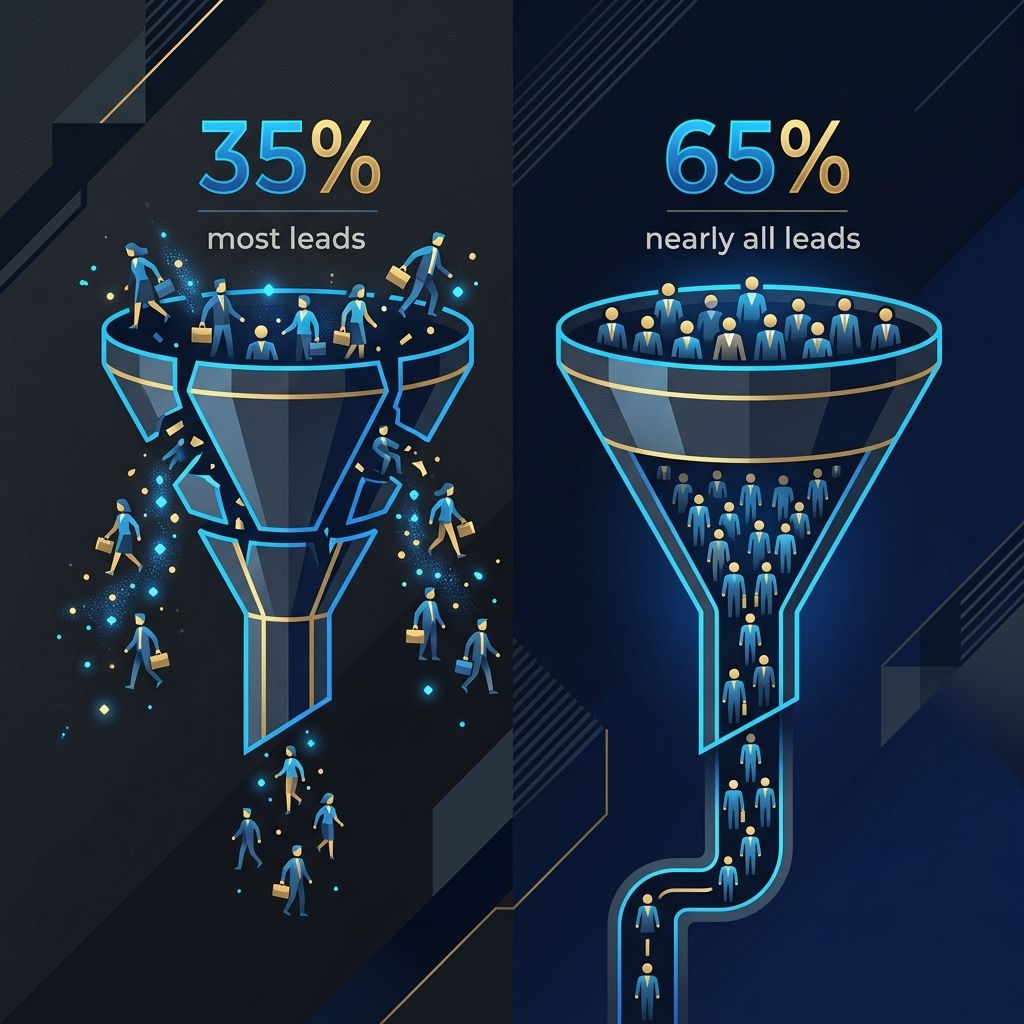
You're Converting 35% of Your Leads matters because service business owners lose revenue when calls, forms, booking, reviews, and follow-up depend on manual attention. The practical fix is to measure the front-door leak, then install the smallest AI-assisted system that answers, routes, books, or follows up faster.
Before I show you the gap, I want to ask you something.
What do you think your lead conversion rate is?
Not the number from your marketing agency's report. Not a rough sense. An actual percentage: of every lead that comes in, call, web form, text, Google LSA, what fraction becomes a booked, paid job?
Take five seconds. Write it down. I'll wait.
Most owners I ask give me a number between 50% and 65%. Some go as high as 70% if they're feeling confident that day.
Here's what I know after running over 200 Front Door Audits:
That number is almost certainly wrong.
When I run a Revenue Leak Diagnostic, the first thing I calculate is the effective conversion rate, not the number the owner thinks they have, but what the call log, CRM, and booking data actually show. I have never run an audit where the owner's estimate was higher than 45%. The average we see is 31%.
That gap, between what you *believe* you're closing and what you're *actually* closing, is where six figures of your annual revenue is living right now, quiet and unclaimed.
Let's go get it.
First: How to Calculate Your Real Conversion Rate
Stop using gut feel. Here's the actual calculation.
Step 1: Total inbound leads for a given month.
Count every unique prospect contact: phone calls, web form submissions, Google LSA leads, texts, social DMs. If someone called twice, count them once. This is your lead volume.
Step 2: Total booked jobs from that same cohort.
How many of those leads became a scheduled appointment *or* a completed job? Not an estimate sent. A booked job.
Step 3: Divide.
Booked jobs ÷ Total leads = your real conversion rate.
Here's where it gets uncomfortable.
Most business owners, when they think about conversion rate, are thinking about *close rate*, meaning, of the estimates I sent, how many became jobs? That might be 60-70% and is genuinely good. But estimates sent is not the right denominator.
The right denominator is every lead that came in. Including the ones that never became a conversation. Including the voicemails nobody returned. Including the Google form that sat in an inbox for 11 hours until the prospect had already booked your competitor.
That's the real conversion rate. And when you calculate it that way, the number almost always drops by 20 points or more.
A plumbing company in Memphis we audited this past spring thought they were converting 58%. When we pulled their actual call log data, total inbound contacts vs. booked jobs, the number was 29%. They were gobsmacked. Three years in business, doing $1.4M in revenue, and they had essentially been leaving half their inbound leads on the table without knowing it.
The Five Places Conversion Leaks Out
The gap between 35% and 65% is not random. It happens at five very specific points. And once you see them, you can't unsee them.
Gap 1: Speed of First Response
This is the single biggest driver of conversion rate in service businesses, and it's also the most chronically underestimated.
A Harvard Business Review analysisfound that companies that respond to a new lead within 5 minutes are 100 times more likely to qualify that lead than companies that wait 30 minutes. *One hundred times.* In service businesses with average response times of 2-4 hours, and after-hours voicemails that sit until morning, this isn't a small inefficiency. It's a structural loss.
Think about how a prospect actually behaves.
They need a plumber. Their kitchen is backed up. They Google "plumber near me," they get three options, they call all three in a row. Maybe they fill out two web forms. Then they wait.
The first business to actually reach them wins. Not the best business. Not the one with the most reviews. The first one to have a real conversation.
We see this in 9 out of 10 audits. The top-performing businesses, the ones converting at 60%+, have some form of instant-response coverage. An answering service, a trained team member, or an AI voice agent. They are never the business that goes to voicemail at 6pm.
The average business has a real response time, including after-hours, of 3.5-4 hours. The top operators have a response time measured in seconds.
That gap, by itself, accounts for 10-15 percentage points of conversion difference.
Gap 2: Quality of First Interaction
Answering the phone is necessary. But it's not sufficient.
The first interaction a prospect has with your business sets the entire emotional trajectory of whether they become a customer. A confused handoff, an employee who sounds distracted, a failure to ask the right qualifying questions, all of these cost you jobs.
Here's something most owners don't track: their first-contact resolution rate. Meaning, of the leads that are actually reached, what percentage get fully qualified, get an appointment scheduled, and convert to a booked job in that first conversation?
In low-converting businesses, first-contact resolution is around 40-50%. Meaning even when you *do* answer the phone, you're losing half those leads before they book.
In high-converting businesses, it's 75-80%. The difference is a trained interaction. A script. Questions that move the call forward. A system.
I had a client, a Charlotte plumbing company we audited last spring, whose dispatcher was excellent at customer service but had never been given a clear script for converting inbound calls into booked appointments. She was friendly. Customers liked her. And they frequently hung up without a booking because she wasn't trained to ask for it.
We gave her a 6-question script and a clear handoff protocol. Their first-contact conversion jumped 18 points in 60 days. Same dispatcher. Same calls. Different system.
Gap 3: The Follow-Up Sequence (Most Businesses Have None)
This one is so consistent I've started building it into my audit assumptions before I even ask the question.
Most service businesses have zero structured follow-up sequence for unconverted leads. Maybe a callback attempt the next day if someone remembered. Sometimes a text three days later. Almost never a systematic, multi-touch process.
Top-performing businesses treat every unconverted lead like a warm prospect with a specific window.
Here's the reality of the window: about 20% of leads that don't book on first contact will book within 48 hours if followed up correctly. Another 12% will book within 7 days. After that, the curve flattens sharply, not to zero, but to diminishing returns.
So the question isn't whether to follow up. The question is: do you have a system that ensures every unconverted lead gets a specific touchpoint at 2 hours, 24 hours, 48 hours, and 7 days?
For most businesses I audit, the honest answer is no. They have *intentions* but not a *system*. And without a system, follow-up is only as good as whoever remembered to do it that day.
A landscape company in Phoenix we worked with had been running Google Ads for 18 months. They were spending $6,200/month. Their conversion rate was 32%. When we audited their follow-up process, we found that roughly 65% of their inbound web leads were receiving zero follow-up after the first unanswered call.
We implemented a 5-touch automated follow-up sequence, two calls, two texts, one email, over a 7-day window. Within 90 days their conversion rate was at 48%. Same ad spend. Same leads. Sixteen additional booked jobs per month.
Gap 4: Review Trust Signal (The Invisible Conversion Killer)
Here's the one that genuinely surprises people.
Your Google review profile is actively converting or unconverting prospects before they ever pick up the phone.
BrightLocal's consumer researchconsistently finds that 98% of consumers read online reviews for local businesses, and that businesses with fewer than 50 reviews or below a 4.3-star average see meaningful drops in click-through and inquiry rate compared to competitors with stronger profiles.
Here's the math implication that most people miss:
If your review profile is causing 15% fewer people to call you than your competitor across the street, you're not just losing 15% of potential leads. You're losing 15% of leads *at the top of your funnel*, which compounds through every downstream conversion stage.
And when those leads that do call you are simultaneously checking your reviews while they're on hold, whichresearch shows a significant portion do, a weak review profile reduces the quality of that first conversation.
I've seen businesses with a 3.9-star average on 12 reviews competing against businesses with a 4.7-star average on 180 reviews in the same zip code. The gap in inbound lead volume and close rate is significant, even when the actual service quality is comparable.
Reviews are not vanity. They are a structural component of your conversion funnel.
Gap 5: Estimate Follow-Up
This is the gap that's closest to pure money being left on the counter.
Most service businesses send an estimate and wait. If the prospect calls back, great. If they don't, the job is considered lost.
The data I see in audits says that 22-30% of unsold estimates, jobs where you showed up, did the diagnostic, sent a price, could have been converted with a structured follow-up. Not aggressive. Not pushy. Just: "Hey, I wanted to make sure you received the estimate. Do you have any questions?"
One follow-up call, made within 48 hours of estimate delivery, closes a meaningful fraction of jobs that would otherwise go to a competitor. Two touches, a call and a text, closes more.
We see this most clearly in HVAC and roofing, where estimates are high-dollar and customers legitimately need time to decide. The businesses converting 60%+ of their estimates are almost always the ones doing systematic follow-up. The ones at 40% are waiting.
What Closing the Gap Is Worth in Dollars
Let me make this concrete.
Assume you're a service business doing $1.5M annually. You're generating 180 leads per month. Your average job value is $850. Your current conversion rate is 33%.
You're booking59 jobs per month.
Now assume you implement the five systems above, instant response, trained first interaction, structured follow-up, review building, estimate follow-up, and you get to 52% conversion over 90 days. (Achievable. I've seen it done faster.)
You're now booking93 jobs per month. Same lead volume.
That's 34 additional jobs at $850 average =$28,900 per monthin additional revenue.
Annualized:$346,800.
From the same number of leads you're already paying for.
This is not speculative. This is arithmetic. The only variable is whether you build the system.
The Calculation You Should Do Today
Pull the last 90 days of data.
Count every inbound lead: calls, forms, texts, DMs. Then count every booked job from that same period. Divide.
If your number is above 55%, you're performing well. There may still be edge cases to improve, but your fundamentals are solid.
If your number is below 45%, you have a structural problem, almost certainly in one or more of the five gaps above, and you're losing significant annual revenue.
If your number is below 35%, this is urgent. You're in the bottom quartile of service businesses by this metric, and you're likely experiencing the symptoms: revenue growing but margin shrinking, constant pressure to buy more leads, a general sense that the business is harder than it should be.
The good news is every one of the five gaps is fixable. None of them requires more ad spend. All of them require a system.
Calculate Your Gap Right Now
Use the**Revenue Leak Diagnostic**to put real dollar amounts on your conversion gap.
Enter your monthly lead volume, your actual conversion rate (the one you just calculated, not the one you guessed), and your average job value. The calculator will show you the annualized revenue difference between your current rate and top-operator benchmarks.
Most owners who run it for the first time see a number between $180K and $420K.
That's the money sitting in your existing lead flow, going to your competitors by default.
Or, if you want me to pull the actual call log data with you and identify which of the five gaps is biggest in your specific business, that's the Revenue Leak Diagnostic.
Fifteen minutes. Free. I'll show you exactly where it's going.
The loss estimate is basic business math, not a magic claim.
Revenue-leak examples on this site are built from visible operating inputs: inquiry volume, missed-call or slow-response rate, booking rate, average job or client value, repeat value, and follow-up recovery. The fastest way to make the number real is to run the diagnostic for your closest business type, then compare it against your own call log, CRM, booking calendar, form timestamps, and review activity.
Connect one customer path before adding more disconnected tools.
The first useful system owns a defined journey from customer action to team handoff and follow-up.

Vikram Roy is the founder of The Quiet Protocol, a Toronto-based systems firm serving service businesses across the Greater Toronto Area, Canada, and the United States. He works directly with professional firms, home service companies, dental practices, clinics, and local businesses to connect websites, customer intake, booking, reviews, follow-up, and practical AI into a clearer digital front door. All content is written from Toronto, Ontario. See the editorial method →
See the system page tied most closely to the problem this article is diagnosing.
Service BusinessesOpen the industry path where this revenue leak is framed in operational terms.
Run Revenue Leak DiagnosticQuantify the leak before you decide what type of system needs to be installed.
Call the AI Receptionist DemoHear the receptionist live, give it your business context, and test a short caller roleplay before you book.
Results & ProofReview what the system changes once the front door is rebuilt around response and continuity.

The Real Cost of a Missed Call for a Service Business: The Math Nobody Runs
A missed call costs more than the immediate job. Here is the full three-layer calculation, immediate value, lifetime client value, and referral chain, and the annual total most owners never see.

What Is a Revenue Leak Diagnostic? The 15-Minute Diagnostic That Reveals Your Service Business Revenue Gap
A Revenue Leak Diagnostic is a structured 15-minute diagnostic that calculates the exact dollar value of revenue a service business is losing at the point of first contact, before a single dollar of marketing is changed.
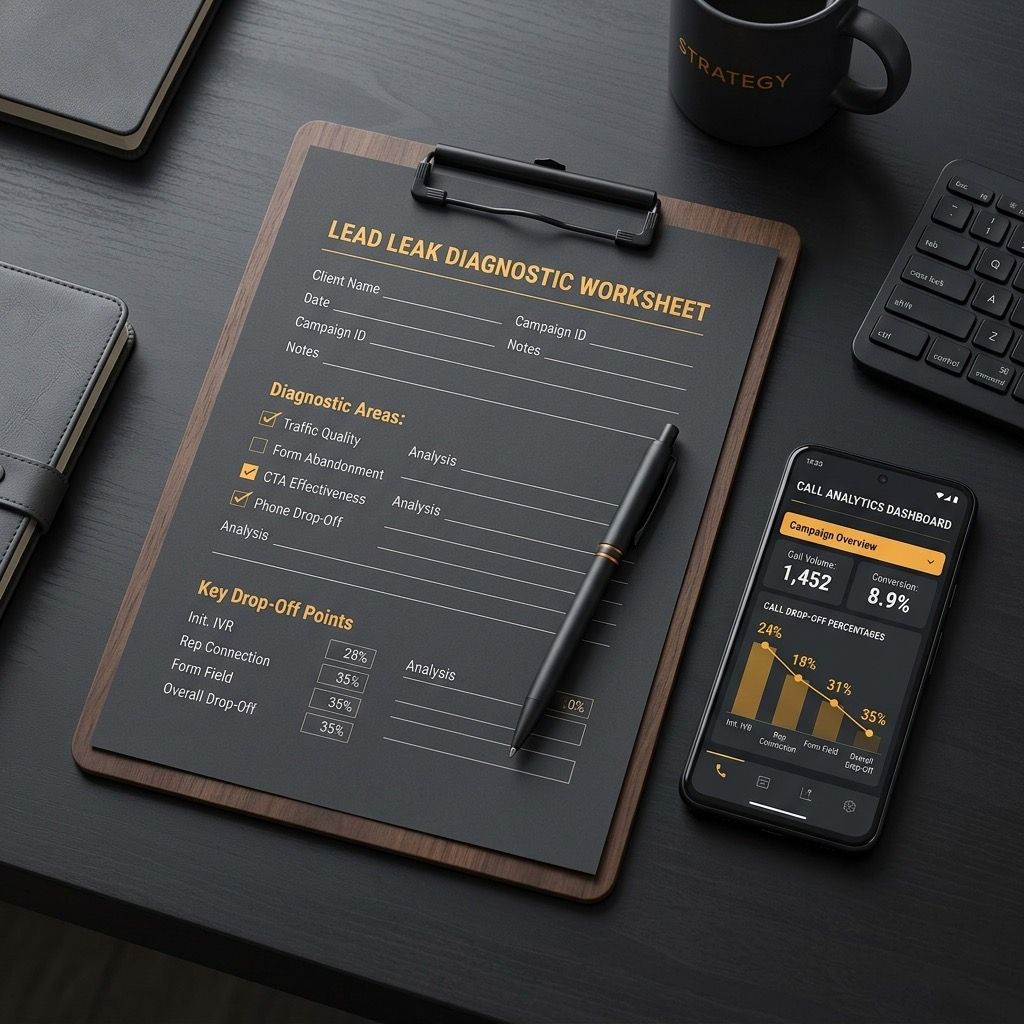
The Service Business Lead Leak Diagnostic: 10 Questions That Reveal Where Your Leads Are Going
Most service businesses are not losing leads to competitors. They are losing them at the front door. This 10-question diagnostic shows you exactly where.
Calculate the revenue leak.
Stop guessing. See how much demand your business may be losing through missed calls, slow replies, weak booking, review gaps, and follow-up drag, then decide whether Voice AI is the right system path.
Run the calculationPrefer to hear it first?
Call the live AI receptionist and test the conversation.
Call the live AI receptionist anytime. Tell it about service businesses, then hear a short live roleplay based on the calls your front desk actually gets.