
To track quote acceptance rates, choose a group of quotes first sent in the same period, let that group reach a sensible decision age, then divide accepted quotes by all eligible quotes sent. Report the declined and still-open quotes beside it.
That denominator is doing real work. If you count only customers who answered, the quiet estimates disappear. Your acceptance rate can improve while the team gets worse at finding out what happened. Very tidy. Also useless.
I would start with one register and one definition of acceptance. You need to know which buying decisions progressed, which were lost and which still need a person. A prettier dashboard can come later.
If your estimates sit between you, your inbox and your office team, I recommend our Estimate Follow-Up System. The Quiet Protocol maps, implements and maintains the agreed quote process, from US$2,500 setup plus US$995 per month, with no contract and call minutes included. We configure the timing, messages, stop rules and owner alerts, then monitor delivery, replies and stage movement. The register below gives that process a clear job to do.
Tracking quote acceptance helps explain your sales conversion rate, but it measures an earlier decision. An accepted quote does not prove that you completed the work or collected payment. Keep those later outcomes separate so this number tells you what changed in the customer decision.
Choose the event you mean by accepted
Write down the signal that moves a quote into accepted status for your business. It might be a signed proposal, a recorded approval, or another defined customer action followed by staff confirmation. Use the same rule within the group you compare.
Do not let a staff member mark “accepted” merely because a customer sounded interested. Do not count a scheduled estimate visit as acceptance of the eventual work. If a customer accepts only part of the scope, record the accepted amount and your rule for counting that decision.
This is a measurement definition, not advice about when a contract becomes legally binding. Your terms and professional requirements still govern the engagement. The register should describe the real action your business needs before moving forward.
Keep accepted, booked, completed and paid as separate events. They answer different questions. A roofing estimate may be accepted while the crew is not yet scheduled. An accounting proposal may be accepted while onboarding is unfinished. If accepted work later cancels, preserve the original acceptance and add the cancellation event. Otherwise you cannot tell whether the problem happened before or after the customer said yes.
Check what your current software can already show. QuickBooks Online, for example, documents customer acceptance or decline, manual status updates and an estimate report containing status and an invoice number when converted. That is useful source material for a register, not proof that the firm's acceptance rule has been followed. Intuit: create, update and report on estimates
Count one buying decision, not every revision
Choose the unit before you count it. Our starting recommendation is one eligible buying decision per customer project or proposed engagement, with a stable identifier and a first-sent date.
If a homeowner requests a revised option for the same bathroom repair, keep it under that decision. Record the revision and revised value. Three versions do not become three separate opportunities just because the estimator pressed send three times.
If an accounting prospect receives genuinely separate proposals for two independent engagements, decide whether those are two decisions and document the rule. Optional packages within one proposal are usually better tracked as the choice made within that proposal. Apply your policy consistently rather than choosing whichever version improves the percentage.
Exclude internal drafts, accidental duplicates and quotes never sent from the eligible sent count. Preserve the exclusion reason. A quote that was sent but bounced belongs in the delivery investigation; removing it simply because the customer never saw it can hide the very failure you need to repair.
Give every estimate somewhere to go
The register can begin in a spreadsheet. Use the existing job or proposal system when it can hold these fields reliably. The important part is that someone can locate a row, understand the last event and do the next piece of work.
The estimate register
| Field | What to record | Why it belongs |
|---|---|---|
| Decision ID and service | Stable project or engagement ID; service and customer type | Match revisions and compare similar work |
| First sent | Date, time, recipient and channel | Choose the cohort and check delivery |
| Quoted value and revisions | Defined original value; current value; revision dates | Keep changes visible without multiplying opportunities |
| Current decision state | Accepted, declined, open, or administratively closed without a decision | Separate customer decisions from unfinished work |
| Decision evidence | Date and location of the customer's approval or decline | Allow a colleague to verify the status |
| Last useful contact | Last reply or conversation; delivery problem if known | Show whether anyone actually reached the customer |
| Next action and owner | Named responsible colleague, action and due date | Make an open estimate actionable |
| Reason and confidence | Customer-stated reason, staff inference, or unknown | Avoid turning guesses into pricing conclusions |
| After acceptance | Booking, completion, cancellation and payment tracked separately | See whether accepted work became delivered work |
If a customer declines, retain the row. Intuit's estimate guidance also recommends changing a rejected proposal to declined rather than deleting it. A missing row cannot teach you anything about why the work was lost. Intuit estimate status guidance
This is where our implementation earns its place. We define which event changes the stage, where a reply creates a task and when a person takes over. We then test the agreed route. Staff should not have to remember whether a customer answered in an inbox that the register cannot see.
Freeze the sent cohort before calculating
A sent cohort is simply the group first sent within your chosen period. Once selected, keep those same eligible decisions in the denominator while their outcomes develop. Do not compare quotes sent this month with any acceptances that happened this month: those acceptances may belong to much older work.
Choose a review age from how your own customers decide. A small repair quote and an annual advisory engagement may need different windows. There is no universal number of days that makes every quote mature. Look at your decision history and report the window you chose.
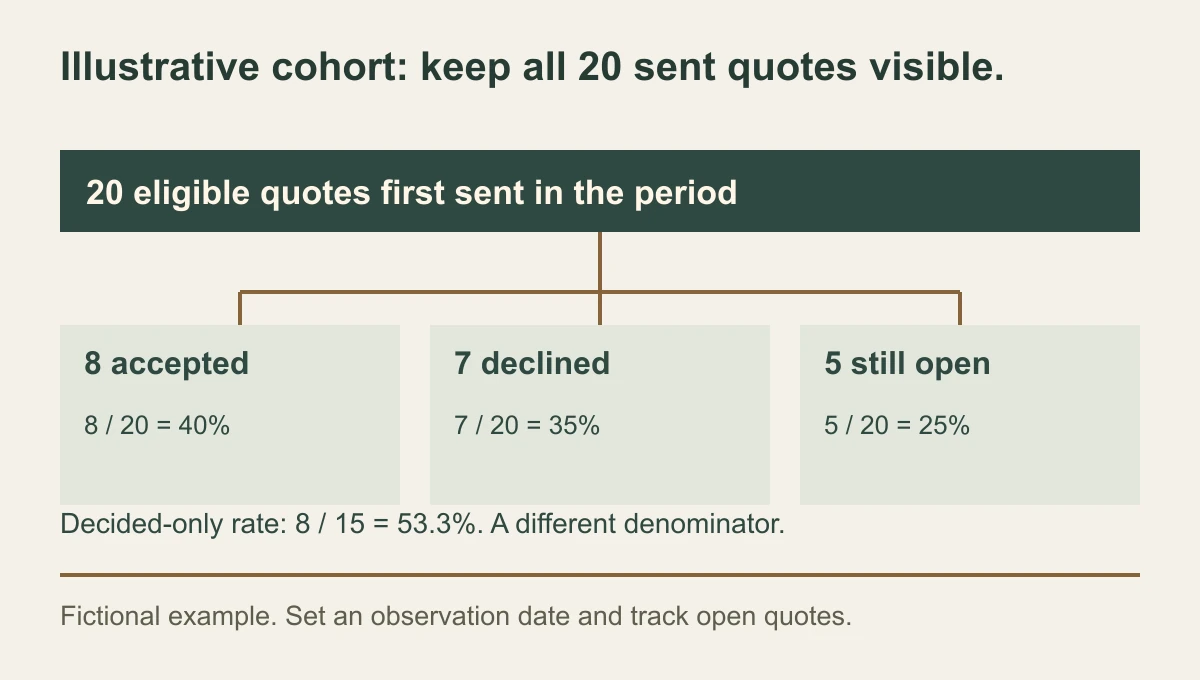
For an illustrative example, take 20 eligible quotes first sent from May 1 to May 31. Review them on July 15, after every quote has had at least 45 days. Suppose eight are accepted, seven declined and five remain open.
Your sent-cohort acceptance rate is 8 ÷ 20 = 40%. The declined share is 7 ÷ 20 = 35%. The still-open share is 5 ÷ 20 = 25%. These are fictional records used to explain the method, not a benchmark or client result.
Keep the twenty in view
- Sent-cohort acceptance: 40%
- Eight accepted decisions divided by all twenty eligible quotes first sent in the period. This is the primary measure in this guide.
- Decided-only acceptance: 53.3%
- Eight accepted divided by fifteen customer decisions. This secondary measure excludes the five open quotes, so label it explicitly.
- Open share: 25%
- Five still-open quotes divided by the same twenty sent. Investigate their age, last contact and next action.
- Accepted does not mean completed
- Track delivery and cancellation after acceptance. Do not quietly replace one numerator with the other.
A mature review date gives decisions time to arrive. It does not justify deleting the opportunities that remain unresolved.
If an open quote later accepts, update its outcome within the same sent cohort and keep the new as-of date. Show both snapshots when you compare them. A later review naturally contains more decision time; that alone is not evidence of better follow-up.
If your policy closes an unanswered quote after a defined period, call it closed without a customer decision. Keep it in the sent denominator. “No reply” and “customer declined because of price” are different findings.
The reason column should resist wishful thinking
Use a short list of reasons your staff can apply: price or value, service fit, timing, competitor selected, customer postponed, capacity unavailable, delivery failed, or unknown. Add a brief note where it helps. Keep the list small enough that two colleagues can code the same reply similarly.
Record whether the reason came from the customer. “Customer said the start date was too late” supports a scheduling investigation. “Probably too expensive” is a staff inference. Treat it as a question to test, not permission to discount every future estimate.
An administrative closure may have no customer reason at all. Do not force the receptionist to choose one to make the report complete. Unknown is an honest answer and a useful measure of how much the business still needs to learn.
Our estimate follow-up guide covers the messages and reply process. This article owns the register and measurement. Use the message that helps establish a real decision, then record the answer here.
Find the gap before changing the price
Sort open quotes by age and inspect the last useful contact. A large group with no assigned next action points to ownership. Bounced messages point to delivery. Many customer replies waiting for a person point to a handoff. Known declines over a start date point to capacity. Each calls for different work.
Compare acceptance within service types and customer groups before relying on the overall figure. A month containing more large, complex projects may move differently from one filled with routine repairs. Show counts beside rates: three acceptances out of five quotes should not carry the same confidence as sixty out of a hundred.
If quote values differ greatly, report a separate accepted quoted-value share using a declared value policy, such as accepted scope divided by original sent scope value. Revisions and partial acceptances can change that calculation, so keep them visible. This is quoted work, not collected revenue or contribution profit. Use the unconverted-lead worksheet when deciding what an improvement can afford.
Check the customer's side as well. If an online action records acceptance, test that the confirmation describes what actually happened and where the record lands. W3C's guidance calls for clear success and error feedback; your wording also needs to distinguish a submitted response from a decision your business has recorded. W3C: form notifications
Give the register a working routine
At your review, take the oldest open estimates first. Confirm the evidence, next action and responsible colleague. Then inspect a few accepted and declined rows to check that staff are using the same rules. Compare mature sent cohorts of the same age when reviewing change over time.
A spreadsheet is a sensible start when someone can keep it current. When replies, reminders and stage changes regularly need chasing across several tools, I would put the process into a system the team can trust. That is the work we sell: configure the agreed Estimate Follow-Up System, test the acceptance and exception routes, and maintain the delivery, reply and owner handoffs within scope.
Bring us one traceable group of sent estimates, including the unanswered ones. Put your quote pipeline to work with TQP. Your team should be able to open the record and know the next action. You should be able to read the acceptance rate and know exactly who is still waiting inside it.
Frequently asked questions
How should a business track estimate acceptance?
Define the estimate state, the decision window and what counts as acceptance before calculating a rate. Keep open, declined, expired and unclear outcomes separate so the report reflects the actual work.
Can a low acceptance rate prove the price is wrong?
No. Fit, estimate clarity, follow-up and the observation period can also affect the outcome. Trace the specific gaps before making the price carry every explanation.
How does TQP help close the estimate gap?
We connect the approved estimate follow-up, reply handling and receiving responsibility. A yes, no or question becomes visible work, so you can distinguish a customer decision from an inquiry that nobody carried forward.
We map the quote stages, timing, reply ownership, stop rules and human handoffs, then configure, test and maintain the agreed Estimate Follow-Up System. Bring a sample of estimates your team can trace.
Put your open estimates into a managed follow-up process