
I want to tell you exactly what I see when I sit down with a new client for a Front Door Audit.
This article links to 3 external sources beside the claims they support.
# Your Competitor Is Answering Calls at Midnight. Are You?
I want to tell you exactly what I see when I sit down with a new client for a Revenue Leak Diagnostic.
I pull up Google Maps. I search their service category and city. I look at the top 10 results, not the website copy, not the ads, not the star rating. I look atreview velocity.
How many reviews did each company collect in the last 90 days?
In almost every market I audit now, Dallas, Phoenix, Charlotte, Denver, smaller markets too, there's one outlier. One company with 30, 40, sometimes 60 more reviews than anyone near them. Their rating isn't always the highest. But their pace is double, sometimes triple, the next closest competitor.
That's not a marketing campaign. That's not a sudden surge in business.
That's an AI answering every call.
What I'm Actually Looking At
When I show owners this map view in an audit, I get the same reaction: *"Yeah, they're big. They've been around forever."*
That's almost never true. When I dig into the review history, you can pull this with tools likeBrightLocalor just eyeball the timestamps, the acceleration started 9 to 14 months ago. Not 5 years ago. Not after a big marketing push. About a year ago, their call capture improved dramatically. And everything downstream from that improved with it.
Reviews. Rankings. Revenue. Referrals.
The early AI adopter in your market didn't announce anything. They didn't run a press release. They quietly installed a system that answers every call, including the ones that come in at 11pm on a Tuesday, and they started winning.
I can tell you with confidence:this is happening in your market right now.Whether you know it or not is a different question.
The Part That Surprises Every Owner
Here's the thing most people get wrong about this.
They assume the competitor with AI is getting *more* leads. Better SEO, more ad spend, stronger brand. They think the AI is somehow generating demand.
It isn't.
The early AI adopter is competing for theexact same pool of leads you are. Same Google searches. Same ZIP codes. Same desperate homeowner whose AC quit at 9:30 on a Friday night.
What changed is the net. Their net doesn't have holes in it after 6pm.
Research from BrightLocal's annual Local Consumer Review Surveyshows that consumers overwhelmingly call the first business that answers. They don't comparison shop when they have a problem. They call, they connect, they book. Call abandonment when a business goes to voicemail runs high, industry estimates put after-hours voicemail abandonment between 60 - 80% for non-emergency service calls. The caller simply moves to the next Google result.
Same pool. Better net. That's the whole story.
And it compounds.
The 12-Month Advantage, What It Actually Looks Like
Let me walk you through what 12 months of uninterrupted lead capture does to a local service business.
Month 1 - 3: Call capture improves.
The AI answers after hours. Inquiries that would have gone to voicemail, and then to a competitor, now get handled. The business books 15 - 25% more jobs without changing its marketing spend at all.
Month 4 - 6: Reviews accelerate.
More jobs mean more customers. More customers mean more review requests. A well-configured AI voice system follows up post-service automatically. The reviews stack up. On Google, review velocity is a ranking signal. The business starts climbing in local pack results, not because of new SEO work, but because they're completing more transactions.
Month 7 - 9: Rankings shift.
More reviews, more completions, lower call abandonment, Google notices. The business edges up in the local 3-pack. Now they're getting organic impressions that competitors are paying for with ads. Their effective cost per acquisition drops.
Month 10 - 12: LTV compounds.
Service businesses run on repeat customers and referrals. A customer who got a frictionless first experience, including the midnight call that actually got answered, is far more likely to call back for the next job. Referrals from satisfied customers cost nothing. The business now has a growing base of customers its competitor never touched.
At the end of 12 months, the gap isn't just in leads. It's in reviews, rankings, customer relationships, and revenue per marketing dollar.The compound effect of consistent lead capture is not linear. It accelerates.
A Dallas HVAC Story
A Dallas HVAC company came to us through a referral in March. The owner, a 12-year operator, told me business felt "flat" despite a busy season. Good technicians. Good reputation. Decent Google presence.
I pulled up his Google Maps listing against the top 5 competitors in his service area.
One competitor had collected 94 Google reviews in the preceding 5 months. The client had collected 11 in the same window. Their ratings were comparable, 4.6 vs 4.7. But one company was clearly operating at a different velocity.
We pulled the client's call logs going back 90 days. Between 6pm and 8am, there were 67 inbound calls. Eleven of those had left voicemails. The rest, 56 calls, had hung up without leaving a message.
56 calls. No record. No follow-up possible. Just gone.
The competitor with 94 reviews in 5 months was almost certainly answering those calls.
When I showed the owner that number, 56 after-hours calls with no response, he went quiet for a long moment. Then he said: *"That's my slow season in leads."*
It was.
How to Know If You Already Have an AI-Equipped Competitor in Your Market
You don't need to hire me to find out. Here's a 5-minute diagnostic you can run right now.
Step 1: Pull Google Maps for your category + city.
Search "[your service] + [your city]." Look at the top 10 results. Ignore star ratings.
Step 2: Sort by recent reviews.
Click on each listing. Look at the "Sort by: Newest" tab on reviews. Who is collecting reviews fastest? What's the timestamp pattern, are they getting 1 - 2 a week consistently? That's a sign of systematic follow-up, which usually means automated outreach.
Step 3: Test their after-hours response.
Call the top 3 competitors at 9pm on a weeknight. What happens? If one of them answers, a real voice, not a recording, or responds within 5 minutes via text, they have a system.
Step 4: Count your own voicemails vs hang-ups.
Pull your call logs from the last 30 days. Filter for calls between 6pm and 8am. How many voicemails? That number understates reality, callers who hung up without leaving a message show up as missed calls, not voicemails. Count those separately.
Step 5: Compare your review count to theirs.
If the leader in your market has more than 2x your review velocity in the last 90 days, they are running a system. That system is probably answering calls you aren't.
If one competitor passes this test, you are already losing ground to them. Quietly, steadily, compounding.
The Google Ranking Mechanic Nobody Explains
There's a feedback loop here that most business owners don't fully understand, because it involves two systems working together in a way that isn't obvious until you see it from the outside.
Google's local ranking algorithm for service businesses weighs several factors: proximity, relevance, andprominence. Prominence includes your review count and recency, but also your overall engagement signals, how often people find you, click on you, call you, and then don't immediately bounce back to the search results looking for someone else.
A business that answers every call sends better signals across all of these.
More calls answered means more appointments booked. More appointments mean more completed jobs. More completed jobs mean more review requests. More reviews, and recent ones at that, mean higher prominence scores. Higher prominence means higher ranking in the local 3-pack. Higher ranking means more clicks. More clicks mean more calls.
The early AI adopter isn't just capturing more leads. They are *building the machine that generates more leads at lower cost*, month over month, compounding against everyone who hasn't made the same change.
I've watched this play out in markets I've audited. A business that was ranked 4th in the local pack 18 months ago, not bad, but not dominant, is now ranked 1st or 2nd. Their ad spend didn't change. Their website didn't change. Their service area didn't change. Their call answer rate changed. Everything else followed.
What This Looks Like in 3 Years
I'm going to be direct about the trajectory here.
A service business that answered every call for 36 months, while competitors sent after-hours callers to voicemail, will have, conservatively:
- 3 - 4x more Google reviews than those competitors
- Higher local pack rankings, meaning lower effective CAC
- A deeper repeat-customer base from superior first-call experience
- A higher close rate because they had the first conversation every time
The businesses that did *not* adapt will feel this as mysterious, slow, unexplainable stagnation. Revenue is flat. Google rankings slipped. New customers seem harder to acquire. None of it makes obvious sense because no single cause jumps out.
The cause is this:one competitor started answering calls you used to miss, and they haven't stopped.
That's it. That's the whole explanation.
And the frustrating part, the part I genuinely feel for owners when I explain it, is that there is no dramatic moment where you can point to it and say *that's when it happened.* It's a slow bleed. It looks like a mediocre year. It feels like the market got harder, like Google got more competitive, like customers got more price-sensitive. None of those things are necessarily true.
You just stopped being the business that answered.
The remedy is not complicated. But it requires doing it *before* the gap becomes insurmountable, before the competitor's review lead is so large that catching up would take years of perfect execution. The window to act is now, while the market is still in the early innings of AI adoption. In 18 months, every market in the country will have at least one entrenched AI-equipped operator. In some, there will be two or three. The advantage narrows the longer you wait.
The Question to Ask Yourself Right Now
If a homeowner in your city called your business at 10:47pm tonight, the AC is out, the family can't sleep, they found you on Google, what would happen?
If the answer is voicemail, you already know what they do next.
They call the next result. And somewhere in your market, someone is answering that call.
The question is whether you want to be the business that does that answering, or the business that finds out 18 months from now, when you pull up Google Maps and wonder why one competitor suddenly has twice your review count.
→ Find out exactly how much your after-hours gap is costing you: [Run the Revenue Leak Diagnostic](/resources/free-tools/rage-calculator)
→ Ready to close it? [Book a Revenue Leak Diagnostic](/book-a-call)
The loss estimate is basic business math, not a magic claim.
Revenue-leak examples on this site are built from visible operating inputs: inquiry volume, missed-call or slow-response rate, booking rate, average job or client value, repeat value, and follow-up recovery. The fastest way to make the number real is to run the diagnostic for your closest business type, then compare it against your own call log, CRM, booking calendar, form timestamps, and review activity.
Decide what the AI must handle before you choose the software.
A useful intake system begins with the caller journey, the rules, and the human handoff, not a long feature list.

Vikram Roy is the founder of The Quiet Protocol, a Toronto-based systems firm serving service businesses across the Greater Toronto Area, Canada, and the United States. He works directly with professional firms, home service companies, dental practices, clinics, and local businesses to connect websites, customer intake, booking, reviews, follow-up, and practical AI into a clearer digital front door. All content is written from Toronto, Ontario. See the editorial method →
Give the receptionist a realistic scenario and hear how it answers, gathers context, and moves the caller toward a useful next step.
See how the capability in this article fits into a complete customer journey.
Service BusinessesSee the same decision through the language, buyer behavior, and operating reality of this industry.
Client Results & ProofInspect the starting condition, installation, measurement window, and outcome behind real client work.

The Real Cost of a Missed Call for a Service Business: The Math Nobody Runs
A missed call costs more than the immediate job. Here is the full three-layer calculation, immediate value, lifetime client value, and referral chain, and the annual total most owners never see.

What Is a Revenue Leak Diagnostic? The 15-Minute Diagnostic That Reveals Your Service Business Revenue Gap
A Revenue Leak Diagnostic is a structured 15-minute diagnostic that calculates the exact dollar value of revenue a service business is losing at the point of first contact, before a single dollar of marketing is changed.
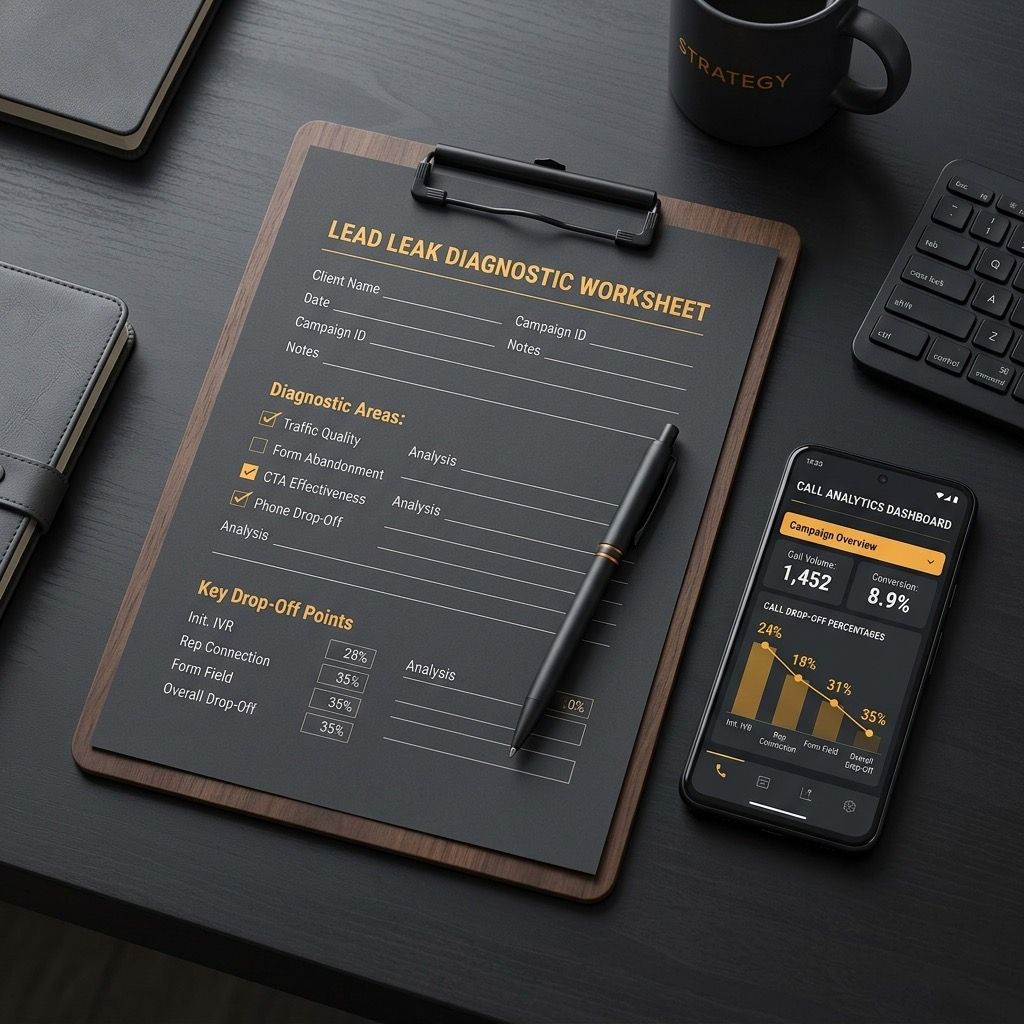
The Service Business Lead Leak Diagnostic: 10 Questions That Reveal Where Your Leads Are Going
Most service businesses are not losing leads to competitors. They are losing them at the front door. This 10-question diagnostic shows you exactly where.
Calculate the revenue leak.
Stop guessing. See how much demand your business may be losing through missed calls, slow replies, weak booking, review gaps, and follow-up drag, then decide whether Voice AI is the right system path.
Run the calculationPrefer to hear it first?
Call the live AI receptionist and test the conversation.
Call the live AI receptionist anytime. Tell it about service businesses, then hear a short live roleplay based on the calls your front desk actually gets.