
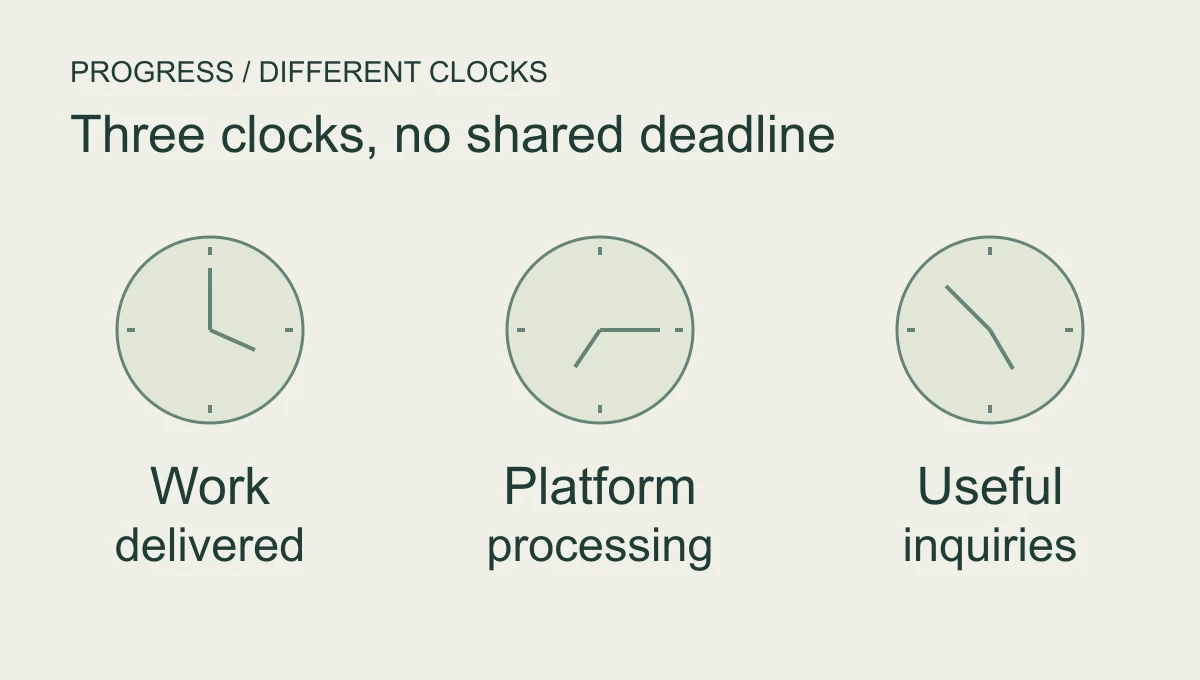
How long does local SEO take? Finishing the work, having a platform process it and attracting suitable inquiries each have their own timetable.
Those are different clocks. A supplier can publish a better page by an agreed date. They cannot make Google promise when that page will produce the next inquiry.
I would ask for a delivery plan before a ranking forecast. It gives you something to inspect while the slower, less controllable part develops. That is why I recommend TQP's Local Ranking Accelerator for the listings foundation: we establish the approved identity, manage distribution and synchronization across the supported network, and keep listing health and corrections assigned to someone. Your business can make useful progress without waiting for a ranking chart to bless every corrected fact.
If you are planning the whole job, start with our local SEO guide for small businesses. It covers profiles, search topics, service pages, reviews and a first-month checklist.
Start the clock when the relevant work can begin
Before judging the timeline, check access and decisions. Does the business control its profile and website? Has someone approved the real services, location and contact information? Is the profile eligible? Is a verification or policy issue blocking ordinary work?
An illustrative accounting practice might approve an engagement in September but leave the agency waiting for website access and its bookkeeping service details. That is not a month of completed SEO failing to produce results. It is a dependency that needs an owner.
Record what is waiting, who can resolve it and the next review point. Do not restart the story from zero every month. Owners should be able to tell whether the work progressed or simply remained in the waiting room.
With TQP, that is a reason to buy continuing management. We can track the connected listing statuses, work through correction exceptions and keep the authoritative record current as your hours or services change. You still provide the real business facts and take part in required verification; the listings routine comes off your desk.
- Baseline recorded. Save the starting information, relevant website pages, reporting access and actual service priorities.
- Agreed work delivered. Identify what changed, where it changed and whether you approved it.
- Publication and processing checked. Distinguish a submitted edit, a public change and website search inclusion. Investigate the applicable status.
- Useful discovery reviewed. Look at relevant visibility and inquiries over comparable periods, then decide the next change.
| Stage | What happens | Rough timing |
|---|---|---|
| Correct the facts | Name, address, phone and hours updated at the source | Central updates are usually live in 24 to 48 hours, some surfaces take up to a week |
| Surfaces catch up | Directories and maps pick up the same details | Days to a few weeks |
| Evidence builds | Reviews, photos and activity accumulate | Weeks to months |
| Position changes | Competition, location and signals interact | Varies. Do not accept a promised date |
Some waiting periods are specific
Google's Business Profile verification guidance says review of submitted verification information can take up to five business days, with rare longer cases. That describes verification. It does not promise a map position when the review finishes.
For website changes, Google's crawl guidance describes days to weeks and says a request does not guarantee inclusion. This is website crawling and indexing, not a timetable for local ranking or booked jobs. Repeated requests are not a shortcut.
Use the status that actually applies. If the profile says it needs verification, deal with that process. If a website page is inaccessible, waiting for a ranking will not repair the page. If a change is public but not producing useful discovery, the question becomes whether the strategy is addressing the relevant demand.
The missing-profile guide helps distinguish these cases. It is worth doing that diagnosis before accepting another reassuring calendar estimate.
A corrected fact and a stronger position are different outcomes
Correcting the phone number gives customers a more accurate route. It is useful even if a ranking chart barely moves. Publishing a clearer service page can make the offer understandable. It still does not entitle the business to a particular position.
Google says local results depend principally on relevance, distance and prominence. The searcher's location remains part of the picture. A citywide ranking claim should tell you which service, search location and measurement it represents. Google's local guidance is the starting point, not a formula a supplier can fully control.
This is why the elapsed-time question needs a specified change. “We have worked on SEO for three months” does not tell you whether anybody corrected the profile, fixed a site problem or wrote the page a customer needs.
Agree how you will review progress
Choose a regular reporting cadence suited to the engagement and enough comparable evidence for the decision. Monthly reporting can be useful for an ongoing service; it is not a rule that every result should arrive by the first report.
Compare similar periods and note seasonal changes, altered budgets or changes in the services you accept. Keep the work log beside the outcome data. Avoid treating one quiet week or a single strong inquiry as proof of the whole programme.
For Business Profile reporting, a call-button click is not an answered call. Google's performance definitions also say the report can include both organic results and Google Ads. Pair those measures with your own inquiry records before declaring growth in qualified customers.
If a supplier promised a deliverable and did not complete it, ask about that promptly. There is no need to wait out an invented SEO incubation period to ask where the service page is.
If the work was delivered but relevant discovery remains weak, review the assumptions: service demand, geography, competition, page usefulness and the next priority. Ask what evidence would make the supplier change course. Patience is useful. Unexamined repetition is expensive.
Ask for commitments the supplier can keep
I would expect an agreed scope, named dependencies, delivery dates for controlled work and a candid explanation of measurement limits. I would also expect the next report to show what happened to the previous report's recommendations.
Progress needs a record you can inspect. Judge the continuing responsibility as well as the elapsed time. The monthly-deliverables guide gives you questions for that review.
Choose Local Ranking Accelerator annual for a sensible first year of maintained public identity: US$990 prepaid for twelve months for one location, equivalent to US$82.50/month, no setup fee and one-time Google Business Profile optimization included. The initial optimization gets the profile configured; the continuing synchronization, monitoring and correction work keep the foundation cared for afterwards.
Bring us the profile, the website and the service you want people to find. We can show what changes first and which next improvement belongs in a separate website or intake plan. You get a team carrying the work and a progress conversation grounded in what actually happened.
Frequently asked questions
How long should a business wait for local SEO results?
Distinguish the work being completed from a change in search visibility and useful inquiries. Some platform steps have specific waiting periods; broader outcomes depend on the business, market and work. Agree review dates and evidence rather than a guaranteed ranking deadline.
Does correcting a listing guarantee a better position?
No. A correction can make an important fact accurate without settling how the business appears for every search. Verify the corrected information and assess the wider discovery path separately.
What can TQP commit to in local search?
We can define the supported listing work, maintenance responsibility and agreed reporting. Local Ranking Accelerator puts that work into a managed routine. Search positions and customer choices remain outcomes to observe, not promises to manufacture.
Local Ranking Accelerator annual includes the initial profile optimization and twelve months of continuing listings care. See what TQP will change, monitor and keep current while platforms process the work.
Start local upkeep with visible progress