
DIY local SEO costs nothing to start and a surprising amount to keep up. Accurate profiles, consistent listings and ongoing corrections need someone to carry them every month, long after the exciting setup afternoon is over. Decide which of that recurring work you want off your desk.
My recommendation is to keep the business decisions and let us build the local presence around them. TQP's Local Ranking Accelerator helps customers discover you across supported maps and directories, with consistent business information and links to your website. You supply the true hours, services and contact details; we handle distribution, duplicate review and continuing care. The point is more ways to find you, with fewer dashboards for you to manage.
The publisher network includes recognizable search, map and review destinations such as Google, Apple, Bing, Yelp and Facebook, with your actual connections confirmed for the business. TQP keeps the connected details synchronized, monitors listing health and handles correction exceptions. It is continuing management, rather than a freelancer sending a set of submissions and returning the logins to you.
Google says a small local business can probably do much of the work alone. It also recommends learning the basics even if you eventually hire someone. That is sensible advice: you should be able to understand what you are paying for. Google's guidance on whether you need an SEO
The question is less “Could I learn this?” and more “Will someone do the work when the business gets busy?” Plenty of owners could learn to do another job. They already have several.
If you are planning the whole job, start with our local SEO guide for small businesses. It covers profiles, search topics, service pages, reviews and a first-month checklist.
The free tools do not do the work for you
Start with a profile that accurately describes the business, a website that explains the services and a working route for inquiries. Google's local guidance emphasizes complete, accurate business information. It also explains why location and relevance still matter when a business becomes better known. Google's local ranking guidance
For a single-location accounting firm, useful owner work might include correcting holiday hours, making sure bookkeeping and tax services are described accurately, asking for honest customer feedback and checking what prospective clients ask for. You already know which services you offer and which requests you decline. That knowledge cannot be outsourced entirely.
The website can change the calculation. If a service page has the wrong description, you may be able to correct it in the editor. If the page disappears after a site move, the contact form fails or nobody can explain why important pages are absent from search, you may need someone who can diagnose the site safely.
A tool reporting a problem does not mean you have to solve it alone. Buy the kind of help the job needs: a specific website repair for a specific fault, and maintained listings when keeping the information current is an ongoing responsibility.
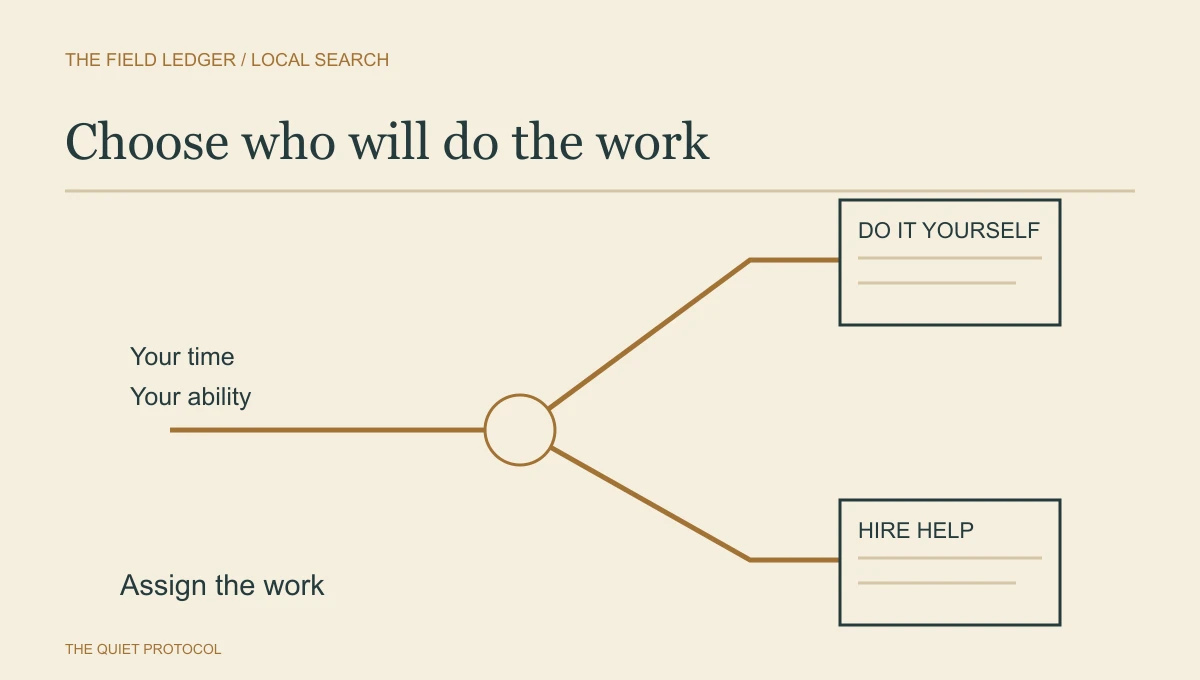
Choose the arrangement that survives an ordinary week
Here is how I would compare the three options. These are working recommendations, not measured time or cost benchmarks.
| Arrangement | Fits when | What you still carry |
|---|---|---|
| Maintain it yourself | The profile and site are manageable. Someone can update them, notice problems and review inquiries consistently. | Learning, making changes, checking results and keeping the routine alive. |
| Hire for a defined project | A known gap needs help: repair a site move, clarify services, fix tracking or establish the foundation. | Supplying accurate information, accepting the completed work and maintaining the handover. |
| Hire ongoing support | Priorities keep changing, several locations need attention, or worthwhile work repeatedly sits unfinished. | Approving business facts, supplying real evidence and reviewing customer outcomes with the provider. |
In plain language: keep straightforward maintenance in-house when it gets done. Buy a project when the problem has a finish line. Buy recurring help when you need someone to keep choosing and completing useful work.
For example, suppose the accounting firm's old website redirects visitors to the wrong services after a rebuild. I would buy help with that repair and ask for a documented handover. I would not use the broken redirects alone to justify a year of unrelated content production.
Now suppose the firm has several offices, conflicting hours online, neglected service pages and no way to tell suitable inquiries from existing-client calls. There may be an ongoing job for a capable provider. The proposal should say which parts they will own, which require your team's input and what they will leave alone.
Count the time you actually spend
DIY has a cost even when there is no agency invoice. Keep a short work log during a normal period: task, time spent, result and anything still unresolved. Include learning, troubleshooting and checking the outcome. Your recollection on a quiet Friday may omit the evening spent wondering why an edit did not appear.
Then compare that with a written proposal for the same work. Separate the setup project, recurring service and any tools or extra development. Do not compare your work on one listing with a quote covering several locations and a website overhaul.
I would also ask what your time would be used for instead. If you would use it for billable work, use your own realistic figures. If you would stop working after dinner, that is a valid reason too. It does not need an invented hourly value to be part of your decision.
This is why I recommend Local Ranking Accelerator annual when you want a broader local presence without doing the listing work yourself. US$990 prepaid covers twelve months for one location, equivalent to US$82.50/month, with no setup fee and a one-time Google Business Profile optimization included. You are building routes for customers to find and contact you, while we keep the information behind those routes current. The network also has documented paths into AI discovery, so this work reaches beyond a collection of directory pages.
The important limit: an agency does not remove every task from you. Someone still has to tell it that the firm has stopped taking new tax clients, approve service claims and explain what made a request suitable. Buying help without allocating that input can leave both parties waiting.
A small DIY trial can settle the question
If you are undecided and the site has no urgent unresolved fault, try a short maintenance routine before committing to recurring help. I would use four weeks as a practical trial, not as a deadline for ranking results.
Pick a named person. Give them a small list: verify business facts, check the inquiry route, make the most useful service correction and keep an inquiry record. Set aside time on the calendar. At the end, ask what was completed, what stayed stuck and how much attention it took.
Use the local SEO measurement guide for the record. The trial tells you whether you can maintain the work. It cannot prove the full search potential of the business in a month.
If the routine happens comfortably, keep doing it. If technical questions block it, buy the expertise. If the work is understood but perpetually postponed, ongoing help may be the better arrangement.
Keep the business in your hands
Whatever you choose, retain control of the accounts. Google provides separate owner and manager roles for the Business Profile, using each person's own account. There is no need to hand an agency your Google password. Google's owner and manager guidance
Ask who will do the work and how you will see it. A service that saves your time should not require you to reconstruct its activity from a dashboard every month. The monthly deliverables guide explains what useful evidence looks like; the agency interview guide helps before you sign.
If you want that work off your recurring list, choose Local Ranking Accelerator annual. Bring the profile, the website and the tasks you have already done. We can identify the ongoing listings work and put any distinct website or intake improvement beside it, with its own purpose and price.
DIY remains a real option when somebody has the time and skill. TQP is the choice I recommend when you want the basics maintained without turning yourself into the firm's part-time listings administrator.
Frequently asked questions
When is DIY local SEO realistic?
It is realistic when somebody has the time, access and discipline to maintain accurate information, useful pages and an honest review habit. Free tools still leave that operating work with the business.
Why choose TQP instead of maintaining listings yourself?
Local Ranking Accelerator helps you build visibility across supported maps, directories and AI-connected networks. TQP handles the distribution, corrections and continuing care, while annual also includes one-time Google Business Profile optimization. You get a broader discovery foundation without taking on another weekly job.
Who should own the accounts when an agency helps?
The business should retain appropriate access and control of its important accounts. Establish that at the beginning, along with what the provider maintains and how the work is reported.
Choose the annual plan for twelve months of supported identity maintenance and included profile optimization. Keep business decisions and account control in your hands.
Grow your local presence with Local Ranking Accelerator