
Choosing Google Business Profile categories feels like a small settings job. It decides which customers Google thinks you serve, so a wrong label quietly sends the wrong calls to your phone.
You can make this unnecessarily difficult by asking, “Which category gets the most traffic?” Before that question, I would ask which work the business can truthfully deliver. Traffic for the wrong job creates an impressive report and an irritated person answering the phone.
At The Quiet Protocol, we make this decision part of a properly described business. Our Local Ranking Accelerator annual plan includes one-time Google Business Profile optimization alongside twelve months of supported listing maintenance. It is US$990 prepaid for one location, equivalent to US$82.50 per month, with no setup fee. I recommend it when you want the profile choices made carefully and the surrounding business details kept accurate afterwards.
Say what the business is, without Google's menu
Write one ordinary sentence about what customers mainly hire you to do. Use actual services, how the business operates and what a customer reasonably expects on arrival.
A hypothetical bookkeeping practice might write: “We keep small businesses' books current and prepare their regular financial records.” A flooring installer might write: “We fit residential floors at the customer's property.” These are descriptions for this exercise, not assertions that those exact sentences or labels appear in Google's category list.
Start with the work, then open the picker. Google's category guidance says to select a specific primary category that best describes the business. If no suitable specific option appears, choose an accurate general one. You cannot invent a new category in that field. Google's category guidance
Do not silently change the sentence to fit a more attractive category. If the practice does not offer a service, choosing its category will not give the team the qualifications or capacity to provide it.
Primary, additional and individual services have different jobs
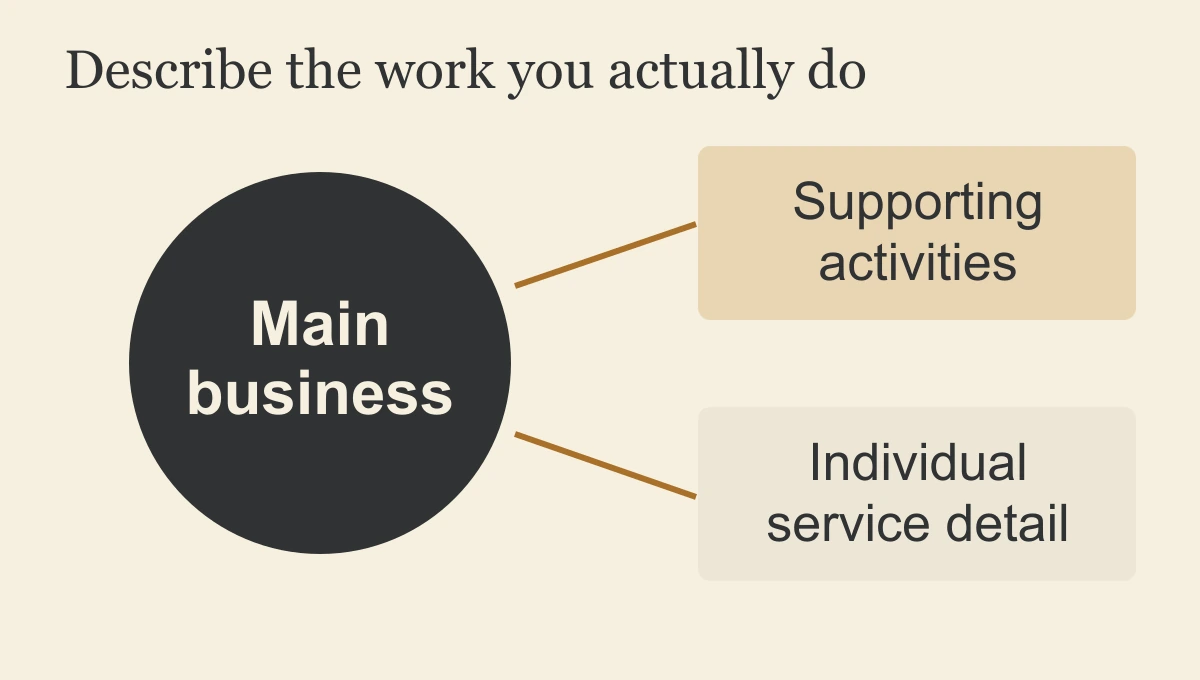
The primary category should describe the main business. Additional categories can describe relevant departments or services, but Google advises using few rather than creating a category for everything you sell. A separately owned and operated public-facing department has its own profile rules. Primary and additional categories
Google's representation guidelines also say categories should describe the business itself, rather than function as keywords or attributes. It is reasonable to want customers to find the specific work you do. It is less reasonable to turn a category list into an imaginary version of the business. Category selection rules
Imagine a service business adding emergency work because it occasionally accepts an urgent request. The useful question is whether that describes a real, advertised, staffed part of the business. If it only means the owner once answered a Sunday text, the category choice may promise more than the operation intends.
Do not borrow a neighbour's category. A business inside a shared building does not gain every other tenant's activities. Likewise, an independent café inside a venue is not simply an additional service of the venue if it is separately owned and operated.
| Business | Primary | Possible additions, if true |
|---|---|---|
| Plumbing company | Plumber | Water heater installation service, Drainage service |
| Heating and cooling | HVAC contractor | Air conditioning contractor, Heating contractor |
| Roofing company | Roofing contractor | Only trades you really perform |
| Accounting firm | Accountant | Tax preparation service, Bookkeeping service |
| Dental practice | Dentist | Emergency dental service, Cosmetic dentist |
| Family law firm | Family law attorney | Divorce lawyer |
Use a short decision record
I would have whoever manages the profile explain the choice in plain English. This is particularly helpful when an agency proposes a change: you should be able to approve the business description without studying a ranking-factor chart.
Category choice sheet
- Main business sentence
- What do customers principally hire us to do, and does our website and real operation support that description?
- Offered primary option
- Which specific option in our actual Google category picker accurately describes that work?
- Additional choice
- Which real supporting activity does this describe? If we cannot name one, leave it out.
- Reason to change
- What became inaccurate or what genuine business activity changed? Record the old and proposed choices.
Competitors can suggest possibilities to investigate. They cannot establish your own eligibility or what your staff should promise. A category on another profile may be inaccurate, and an option mentioned in an old guide may not be offered to your business today.
In our optimization work, the explanation matters as much as the selected field. We want you to recognise your business in its primary category, supporting services, hours and contact details. Local Ranking Accelerator then gives those approved details a maintenance routine across supported listings. You can get back to doing the work the profile describes.
Check the category in your own account. I would not publish a universal list of “winning categories” and ask owners in different places to treat it as current product truth. Use the offered list when making the actual selection.
Make a deliberate edit, then inspect it
The current official path is Edit profile, then the business category field. Select the offered primary category, add a relevant additional category if needed and save. Record what you changed and who approved it. Google says adding or editing a category may require verification again. Prepare for that possibility instead of assuming a harmless cosmetic change. Official editing instructions
Afterwards, check what customers can see. Does the profile still describe the actual work? Are contact information and service descriptions sensible? Does the team understand why the category was chosen? Resolve a verification request through the official process if one appears.
I would avoid a weekly round of experimental category changes with no business reason. If you cannot separate the change from seasonality, other edits and differences in where people search, a short-lived movement in a report tells you little about cause.
An accurate category does not finish local search
Categories affect local ranking, but Google also describes relevance, distance and prominence as factors. Accurate information helps; a category edit cannot responsibly come with a first-place promise. Google's local ranking guidance
The monthly local SEO work guide helps you see how the different jobs fit together. For the profile and supported listing information, I recommend Local Ranking Accelerator annually: the included initial optimization establishes the description, and agreed maintenance keeps the business details current.
Choose a category your team can defend to a customer, then give us the information work to carry. Bring the services you actually want customers to hire you for. We will help make that business clearer wherever the supported listings introduce it.
Frequently asked questions
How should a business choose its primary Google category?
Choose the available category that accurately describes what the business is. Keep additional categories relevant to actual operations instead of turning the profile into a list of services you wish to rank for.
Can a category change replace useful service information?
No. The profile and website still need to explain the real work and provide a reliable next step. A category is one part of that public identity.
How does Local Ranking Accelerator help with category and listing decisions?
TQP reviews the agreed business information, records the relevant decision and maintains the supported listings. You get a practical identity foundation rather than a category experiment with no one responsible for checking it afterward.
Annual Local Ranking Accelerator includes one-time Google Business Profile optimization and twelve months of supported listing maintenance. Let us turn a defensible business description into details you can keep current.
Make your profile describe the work you want