Before
Spring flood season (pre-implementation)
22.9%
of emergency jobs had the insurance packet in within 48 hours
Crew assignment runs on a group chat and a whiteboard with no conflict prevention.
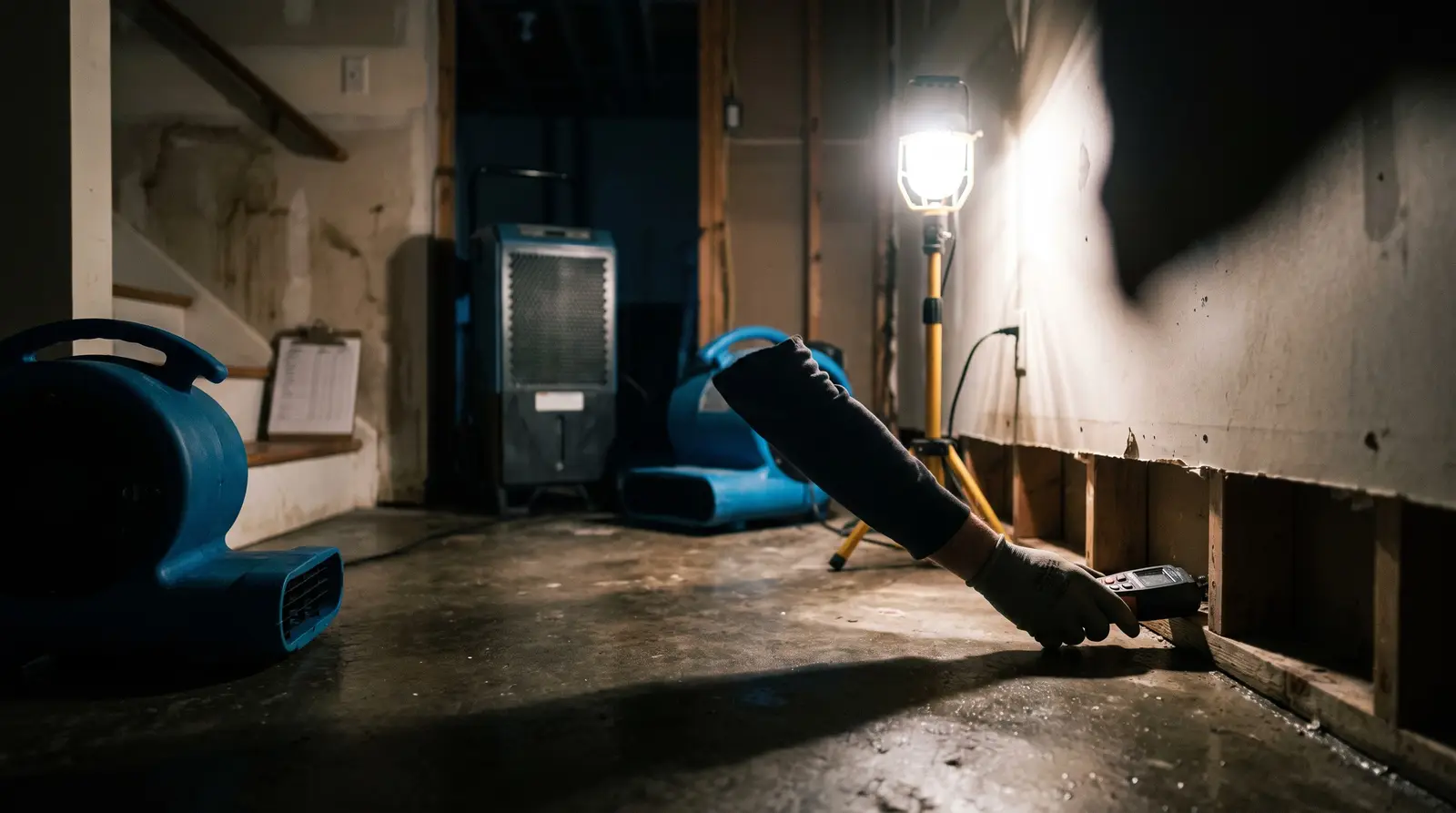
The calls were already being answered. The problem started after the phone was put down.
Supreme already answered almost every emergency call. The trouble started right after: deciding which crew and estimator to send, and whether the office had any real idea where its crews actually were.
During flood and hail season, crews doubled up on the same job while other jobs sat unassigned. Estimators drove out to sites a different crew had already covered. Customers already dealing with water damage waited an extra hour or two for a crew to show. Adjusters noticed the delays too, and paperwork slipped right along with it.
The same operation, drawn twice. Switch sheets or slide the overlay to see what changed, and what stayed the same.
As found. One crew lands on two jobs. Another sits idle. Three emergency jobs wait with nobody assigned.
As built. Every job has one crew and one time, and each arrival checks in so the office can see it.
Product families involved: Custom Business Systems, AI Receptionists and Intake Agents, Follow-Up and Automation.
| Item | System |
|---|---|
| 01 | Custom Business System modeling jobs, crews, estimators, and insurance status as connected records instead of a whiteboard |
| 02 | Automated crew-availability calendar that prevents a crew from being assigned to two jobs at once |
| 03 | AI Receptionist tagging emergency severity and property type at intake so the system suggests the right crew type |
| 04 | Workflow automation compiling photos and moisture readings into an adjuster-ready report on job close |
| 05 | Mobile check-in notifications giving the office real-time visibility into crew arrival and departure |
Read it left to right. Each step depends on the one before it, from the system itself to what the business felt. Take one out and the chain breaks.
Monthly emergency jobs booked, counted at every stage. Each percentage is worked out from the counts beside it.
Before: 22.9%First 90 Days: 85.6%
Of emergency jobs had the insurance packet in within 48 hours. Before: Spring flood season (pre-implementation). First 90 Days: Late summer (post-hail-season steady state).
Spring flood season (pre-implementation)
22.9%
of emergency jobs had the insurance packet in within 48 hours
Crew assignment runs on a group chat and a whiteboard with no conflict prevention.
Early summer (first full month live)
58.7%
of emergency jobs had the insurance packet in within 48 hours
The structured calendar and mobile check-ins are live through the start of hail season.
Late summer (post-hail-season steady state)
85.6%
of emergency jobs had the insurance packet in within 48 hours
Job volume grows as adjuster referrals increase, and the system holds up at higher volume.
Annual labor cost: $37,376 as found, $2,883 as built. Recovered: $34,493 a year.
Modeled at pre-implementation spring job volume versus post-hail-season volume. Higher job volume after implementation still produces less reconciliation time.
Before: 1 in roughly every 2.2 jobsAfter: 1 in roughly every 11.8 jobs
Taken straight from the job counts above, before implementation and at Day 90.
The dispatcher works from a calendar that simply won't double-book a crew, instead of catching the conflict after it's already caused a delay.
A crew shows up when it's supposed to, right when the customer is already dealing with a flooded basement or a fire.
As adjusters learn to trust Supreme, the company can take on more referred claims without hiring more dispatchers. The coordination layer scales. A person doesn't.
Homeowners and adjusters now see a company that arrives organized and on time, right when it matters most to them.
Call capture and job coordination are two different problems. You can fix one and still have the other.
If your phones already get answered but things still fall apart, look at what happens right after the call ends. Answering calls well and running jobs well are two different systems.
The lesson any business can take from Supreme Restoration Group.
Every case here started the same way: the business as it runs today, drawn honestly. A Systems Review does that for yours, then tells you whether the first move is a website, call coverage, connected follow-up, or something custom.