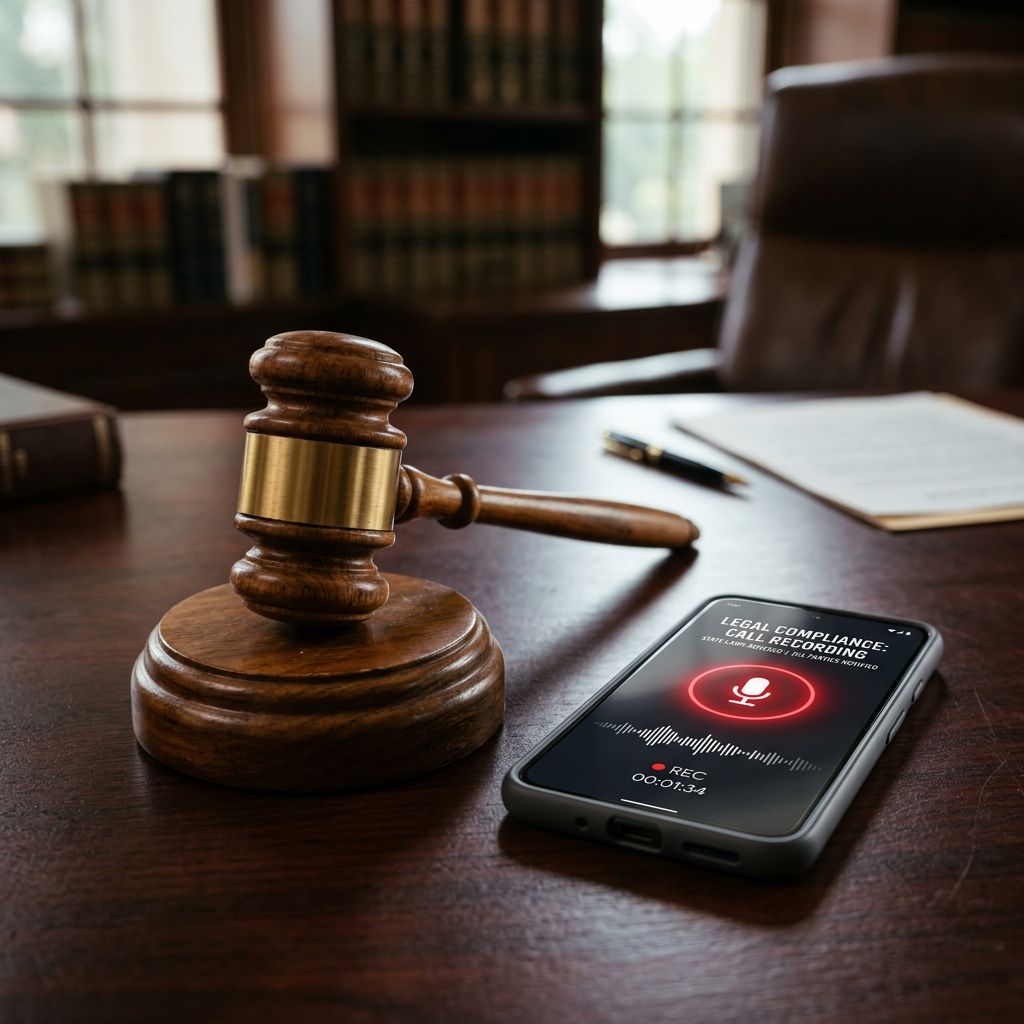
Law Firm field guide: Every State Has Different Call Recording Laws. Here's What Service Business reviewed through response speed, booking friction, CRM
Treat any number without a nearby source or stated method as a planning assumption, then replace it with your own records.
"This call may be recorded for quality assurance purposes."
That one sentence, or the absence of it, is the difference between a compliant AI receptionist and a legal liability sitting inside your phone system right now.
If you've deployed a voice AI to answer your business calls, you need to read this. Not because it's interesting compliance trivia. Because your vendor probably didn't tell you this when they set you up. And because if they got it wrong, the exposure is yours, not theirs.
Why This Matters More Than You Think
Every major voice AI platform records calls. That's not a feature, it's a necessity. The AI needs audio to transcribe, transcription to interpret, and recordings for the quality review that keeps the system improving. Recording isn't optional. It's structural.
What's not universal is the legal requirement around disclosing that recording to the person on the other end of the line.
And this is where the laws diverge sharply by state, in ways that most service business owners have never been told about.
One-Party vs. All-Party Consent: The Only Two Categories That Matter
US federal law, under the Electronic Communications Privacy Act of 1986, operates on a one-party consent standard. That means only one person in a conversation, you, or your AI, acting as an agent of your business, needs to consent to the recording. Federal law doesn't require you to tell the caller that the call is being recorded.
But federal law is the floor. States can, and do, set a higher bar.
One-party consent states (the majority): You can record the call without disclosing it to the other party. You or your system are a party to the call. Your consent is enough. No announcement required.
All-party consent states (the minority, but the consequential one): Everyone on the call must consent to it being recorded. The practical implementation of this is a disclosure at the start of the call. If you record without one, you've potentially violated the state wiretapping statute, a law originally written for wire fraud, now applied to phone recordings.
The penalties in all-party consent states aren't regulatory slaps. They're civil causes of action. Callers can sue.
The 13 All-Party Consent States
Here are the states where your AI must include a disclosure before recording a call:
- California
- Connecticut
- Florida
- Illinois
- Maryland
- Massachusetts
- Michigan
- Montana
- Nevada
- New Hampshire
- Oregon
- Pennsylvania
- Washington
If your business operates in any of these states, meaning your callers are located in these states, the recording consent rules apply. "Where my business is incorporated" is not the relevant question. "Where the person picking up the phone is standing" is closer to the relevant question, though the analysis can get nuanced.
Let me walk through a few states where the rules or the enforcement history are particularly notable.
California, The Strictest, and the One Everyone Should Know
California's Invasion of Privacy Act (Penal Code § 630 et seq.) is widely considered the most aggressive all-party consent statute in the country.
It requires all parties to a confidential communication to consent to recording. "Confidential" has been interpreted broadly, and courts have generally sided with plaintiffs when businesses failed to disclose.
The civil penalty is actual damages, punitive damages, and attorney's fees. There are California Penal Code violations that attach criminal liability too, though civil suits are the more common mechanism for business-related recording violations.
If you operate any service business in California, HVAC, dental, law firm, staffing agency, moving company, and your AI is recording without a disclosure, you are operating outside what California law requires.
California businesses, or businesses that take California callers, need a disclosure. Full stop.
Florida, The One That Surprises People
Florida Statute § 934.03 is Florida's all-party consent law. What surprises operators who know California law but not Florida is that Florida is frequently included in the same risk tier.
Florida has been enforced. There's case law. There are plaintiffs' firms that specifically pursue recording violations. Florida's business environment, insurance agencies, real estate, contractor services, healthcare, produces high call volumes across industries that are rapidly adopting voice AI.
If you're a Florida service business deploying an AI receptionist and your vendor didn't mention this to you, that's a problem. Ask them directly.
Illinois, BIPA Adjacent, But Different
Illinois has the Eavesdropping Act (720 ILCS 5/14-1 et seq.), which requires all-party consent. Illinois is also the state that brought us BIOMETRICS in the form of BIPA, the Biometric Information Privacy Act, which set a national precedent for aggressive privacy litigation.
The litigious environment around privacy in Illinois is well-documented. If you're an Illinois business, a Chicago staffing agency, a Springfield contractor, a suburban dental practice, and your AI is recording calls without a disclosure, you're operating in a state that has shown it will enforce privacy statutes.
The Others, Don't Underestimate Them
Montana, New Hampshire, Oregon, and Nevada don't generate the case law headlines that California does, but their statutes exist and carry civil liability. Maryland and Massachusetts are active jurisdictions with established plaintiffs' bars. Michigan, Connecticut, Pennsylvania, and Washington complete the list.
The common thread: all-party consent means all parties must have the opportunity to consent, and the practical mechanism for that consent in an automated inbound call system is a verbal disclosure at the start of the call.
What a Compliant Disclosure Actually Sounds Like
Here's an example of compliant opening disclosure language:
"Thank you for calling [Business Name]. This call may be recorded for quality assurance and service improvement purposes. If you do not wish to be recorded, you may request to speak with a team member or call back during staffed hours."
That's it. It doesn't have to be long. It doesn't have to be legalistic. It has to be present, delivered before the call's substantive content begins, and audible to the caller.
Some businesses prefer a shorter version:
"Thank you for calling [Business Name]. Please note this call is being recorded. How can I help you today?"
Both work. The key elements are: (1) disclosure happens before the call's content, (2) the caller is informed the call is being recorded, and (3) there's no deception about it.
What to check before you choose a fix
Before buying another answering service, chatbot, phone tree, or AI receptionist, look at the actual path a consultation, case-fit, emergency, referral, or document-review inquiry takes when they reach your business. The first question is not whether the tool sounds impressive. The first question is whether the buyer gets a clear next step while they still care. In law firm operations, that usually means a fast answer, a useful question, a booked appointment or estimate path, and a follow-up record that does not rely on memory.
A strong system should make the business feel easier to choose. It should reduce the waiting, repeating, guessing, and manual chasing that make a buyer keep searching. If the current setup answers only during business hours, takes a message without qualifying intent, or leaves the follow-up to whoever remembers first, the problem is not only staffing. It is front-door design.
The week-one diagnostic
Run this review over the last seven days before making a decision. Pull the call log, website form submissions, chat history, booking calendar, CRM notes, missed-call list, and Google Business Profile activity. Do not start with opinions. Start with timestamps and outcomes. A small sample is enough to show whether the leak is response speed, qualification, booking friction, review weakness, or follow-up failure.
- Count every missed call and every call that lasted under 20 seconds. Those are often buyers who never became visible in the CRM.
- Count every form or chat that waited more than 10 minutes for a real next step. This is where high-intent demand starts cooling off.
- Mark every inquiry that needed a human callback before booking. That tells you whether the website is explaining the next step clearly enough.
- Review the last five reviews buyers can see publicly. Recency matters because buyers compare proof before they commit.
This is the source method for the article: use your own call log, CRM, booking calendar, form inbox, and Google Business Profile review activity. Public research can explain the pattern, but your own records show where money is escaping in this business.
Where the revenue usually leaks
The leak usually appears in one of four places. First, the buyer calls when the team is busy or closed. Second, the buyer reaches the business but is not qualified clearly enough to book. Third, the buyer receives a polite response but no firm next step. Fourth, the buyer finishes the job or visit but no review, referral, or reactivation path happens after the work is done. Each leak looks small by itself. Together, they decide whether marketing produces booked revenue or only more noise.
For a law firm, the most valuable fix is the one that protects speed-to-consult, fit screening, calmer intake, and referral trust. That is why every state has different call recording laws. here's what service business owners need to know. should be judged by business outcomes, not by novelty. A phone feature that sounds clever but does not improve booked appointments is not enough. A website widget that collects contact details but does not trigger follow-up is not enough. A review tool that asks once and disappears is not enough.
What a stronger system should do
A stronger front door answers quickly, asks the right questions, captures the reason for contact, separates urgent from routine demand, books when rules are clear, sends confirmations, updates the follow-up path, and asks for reviews after the work is done. The system should make the owner less dependent on heroic callbacks and make the buyer feel that the business is organized from the first touch.
The Quiet Protocol treats this as an operating system, not a single widget. Calls, web forms, missed-call text-back, appointment booking, CRM handoff, review requests, and reactivation all need to point in the same direction. When those pieces are connected, a law firm can capture more demand without turning the team into a bigger manual call center.
How to judge whether it is working
Do not judge the system by how futuristic it feels on day one. Judge it by what changes in the business. Useful measurements include missed-call recovery rate, average response time, booked appointment rate, no-show recovery, review request volume, review recency, reactivated past-customer conversations, and the number of leads that have a clear next action in the CRM.
The best early sign is calm. Fewer loose callbacks. Fewer mystery leads. Fewer buyers waiting for a reply. More conversations with a clear status. That is what good automation should feel like to the owner and to the customer.
The practical questions behind this decision.
Is this just a 24/7 answering service?
No. A traditional answering service usually takes a message. A properly designed AI receptionist and front-door system captures intent, qualifies the buyer, routes the request, books when possible, triggers follow-up, and supports reviews after the work is done. Message-taking is coverage. Revenue capture is a fuller operating path.
What should a law firm fix first?
Fix the first place buyers disappear. For some businesses that is after-hours calls. For others it is slow website follow-up, weak booking logic, old leads, or stale reviews. The right first move comes from the seven-day diagnostic, not from guessing.
Will AI make the business feel less human?
Bad automation feels colder than a person. Good automation feels like the business is paying attention. It answers quickly, uses plain language, collects the right information, and hands the buyer to a human when judgment or empathy is needed. The goal is not to remove people. The goal is to stop making buyers wait for basic next steps.
How fast should we expect improvement?
The first lift should come from visibility and speed: fewer missed opportunities and cleaner routing. Deeper gains come after the system has enough real conversations to tune scripts, booking rules, follow-up timing, and review requests. Treat the first month as deployment and calibration, not a magic switch.
Review the trust signals visible before someone decides to call.
The useful question is not only the star rating. It is whether recent proof supports the promise the website makes.

Vikram Roy is the founder of The Quiet Protocol, a Toronto-based systems firm serving service businesses across the Greater Toronto Area, Canada, and the United States. He works directly with professional firms, home service companies, dental practices, clinics, and local businesses to connect websites, customer intake, booking, reviews, follow-up, and practical AI into a clearer digital front door. All content is written from Toronto, Ontario. See the editorial method →
Inspect review recency, response habits, and the public trust signals buyers see before they contact the business.
See how the capability in this article fits into a complete customer journey.
Legal, Financial & AdvisorySee the same decision through the language, buyer behavior, and operating reality of this industry.
Client Results & ProofInspect the starting condition, installation, measurement window, and outcome behind real client work.

AI Intake for Toronto Law Firms: An Ontario Readiness Guide
A practical Ontario-focused guide to prospective-client intake, confidentiality, privacy, conflict gates, human handoffs, and responsible AI system evaluation.

AI for U.S. Law Firms: A Buyer’s Guide to Intake Systems
A practical framework for comparing law-firm AI intake systems, defining professional boundaries, testing failures, and choosing a responsible implementation path.

AI for Personal Injury Law Firms in the United States: Protect More Qualified Consultations
Personal injury law firms in the United States spend more on lead generation per acquired client than almost any other professional service. TV ads. Google pay-per-click. Billboards. Lead aggregators. And then they lose 35 to 55 percent of the cases they paid to generate because intake is slow, follow-up does not happen, and the competitor who answered first signed the client. This guide covers exactly what AI changes for PI firms and what the revenue impact looks like.