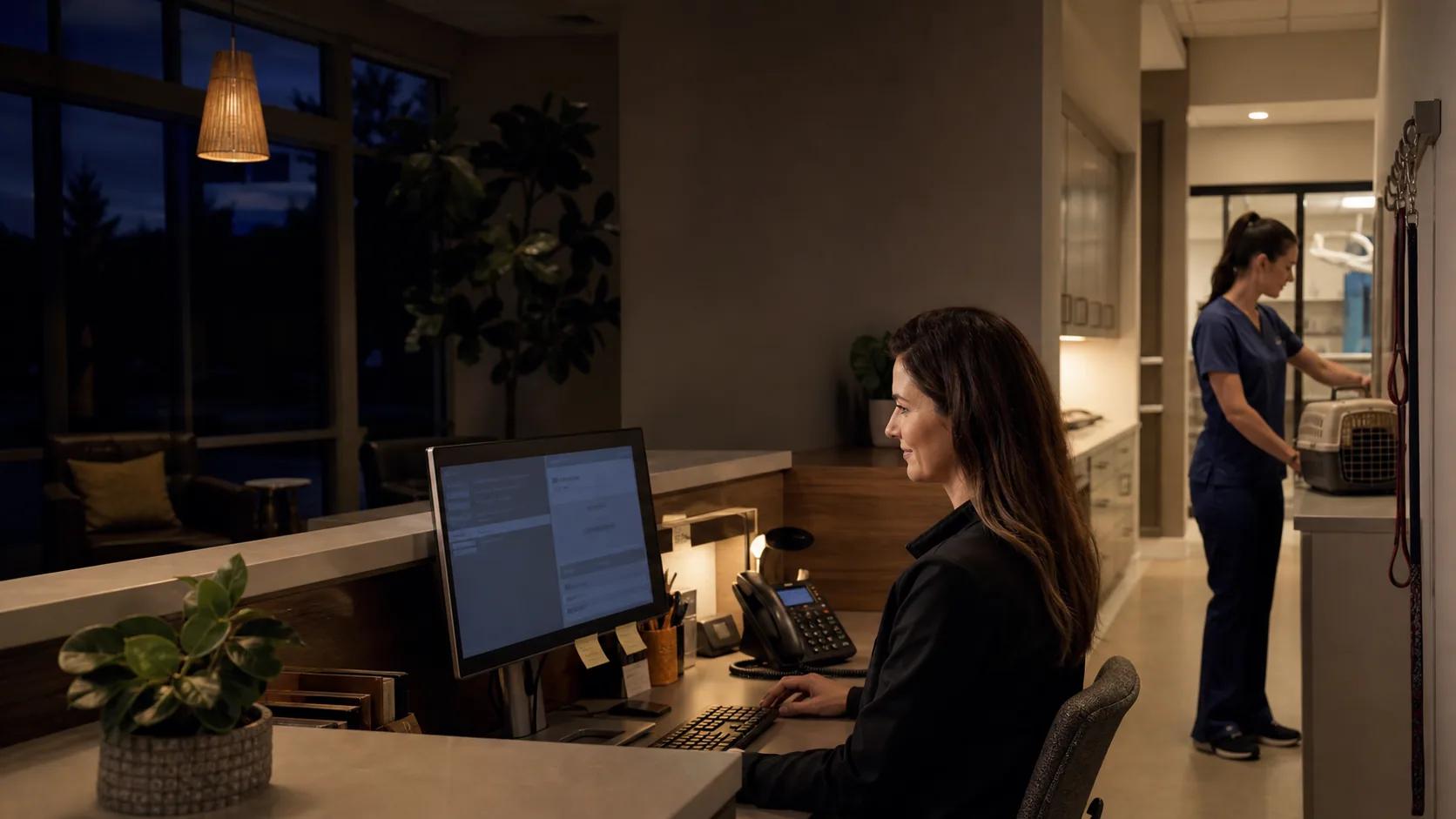
A practical guide for veterinary practices that need a clear, professionally governed path for after-hours calls, emergency referrals, next-day requests, records, and follow-up.
This article links to 3 external sources beside the claims they support.
A veterinary after-hours intake system should provide an immediate acknowledgement, collect a short factual brief, follow the practice’s approved routing rules, and document the next step. It should not diagnose, prescribe, interpret clinical signs, or decide that a patient can safely wait unless an appropriately authorized veterinary professional and the applicable rules support that service.
After-hours intake is not the same as automated veterinary triage
A worried client does not experience an unanswered call as a software problem. They experience uncertainty about an animal they care about. The practice therefore needs a useful first response, but usefulness cannot come from allowing a general automation to act like a veterinarian.
The safe starting point is to separate communication and administrative intake from professional clinical work. A system may acknowledge the call, collect facts in the client’s own words, provide practice-approved contact information, and move the request to an authorized person or facility. That is different from evaluating clinical signs or advising the client that the patient can wait.
The commercial goal is not to make the system sound clinical. It is to make the practice’s real after-hours policy clear, reachable, documented, and easier to follow.
Define the service before designing the conversation
Veterinary telehealth language has precise meanings. The AAHA/AVMA Telehealth Guidelines distinguish teleadvice, teletriage, telemedicine, telemonitoring, and teleconsulting. The AAVSB model documents also distinguish general advice, teletriage, and telemedicine while emphasizing professional judgment and jurisdictional rules.
A practice should name the service it actually provides after hours before writing a script or installing technology. If the practice offers only administrative intake and emergency-facility information, the public experience should not imply live clinical assessment. If a licensed or credentialed team provides teletriage, the workflow should reflect the roles, supervision, documentation, and state requirements that apply.
General information
This may include the practice’s hours, location, appointment process, prescription-request process, and approved emergency contact information. It should remain general rather than becoming advice about a particular patient.
Teletriage
Teletriage involves a timely assessment that helps determine whether a patient needs referral to a veterinarian. The person performing that work, their professional role, their authority, and the governing rules matter. A general AI receptionist is not a substitute for that professional function.
Telemedicine
Telemedicine can involve the practice of veterinary medicine through telecommunications. The suitability of remote care, the veterinarian-client-patient relationship, prescribing, and other requirements vary by context and jurisdiction. Those decisions belong to the veterinary professionals and regulators, not the marketing copy or the intake tool.
Assign clinical and operational ownership
An after-hours path crosses at least two kinds of responsibility. Clinical leadership determines what requires professional assessment, what language is approved, what referrals are appropriate, and where automation must stop. Operations leadership determines who receives the record, who monitors failures, who updates schedules and facility details, and who owns the next-day follow-up.
The policy owner should approve
- The exact after-hours services the practice offers.
- The conditions that require an immediate human or emergency-facility path.
- The language the system may use when it is uncertain.
- The facilities, numbers, hours, and locations the practice is prepared to share.
- The information that may be collected before a professional takes over.
- The documentation, quality review, and change-approval process.
A vendor or automation specialist can help implement the path. It cannot privately invent the clinical boundary on the practice’s behalf.
Create distinct after-hours paths
One generic message cannot serve every reason a client contacts the practice. The routing model should be small enough to understand and specific enough to produce a useful next step.
Emergency information and referral
When the practice’s approved criteria or the client’s own request calls for emergency help, the system should move quickly to the approved human or emergency-facility route. It should not delay the handoff by trying to complete a long intake.
On-call veterinary team
If the practice provides an on-call service, define who is eligible, how the request reaches the professional, what response expectation may be stated, what happens if the first person is unavailable, and how the interaction returns to the patient record.
Next-business-day request
A client may need to request an appointment, refill review, records, or a callback. The system can collect a concise request and offer only the booking or review path the practice has authorized. It should not tell the client that waiting is clinically safe.
Administrative self-service
Hours, directions, existing appointment details, form access, and approved policies may be suitable for direct handling. Protect account and patient information with the same care used during business hours.
Capture a short factual brief
The first record should make the next person better prepared without turning the caller into an amateur diagnostician. Collect what the practice needs for identification, routing, continuity, and contact. Keep clinical interpretation with the authorized veterinary team.
A bounded brief may include
- Client name, callback number, and preferred contact channel.
- Patient name and existing-client status, when the practice can verify it appropriately.
- The client’s description of why they are calling, recorded without rewriting it as a diagnosis.
- The request type, such as emergency contact information, on-call review, appointment request, refill review, records, or administration.
- The route provided, the time, and the person or queue that owns the next action.
- Any failed handoff, uncertainty, or exception that requires review.
If a question does not change the authorized route or prepare the responsible person, it probably does not belong in the first exchange.
Do not let automation interpret clinical signs
The old version of this article proposed that an automated system could ask a short set of clinical questions, decide whether a patient could wait, provide monitoring guidance, and answer medication questions from the patient record. That is not an acceptable default boundary.
A safer system can recognize that the caller is asking for medical guidance and transfer or refer the request according to the practice’s policy. It can record the client’s words. It can present approved emergency contact information. It should not turn those words into a diagnosis, recommend medication, provide home-care instructions, or assure the client that the situation is non-urgent.
Use AI for preparation, not unsupervised clinical judgment
AI can be useful for acknowledgement, administrative questions, language handling, structured data capture, authorized booking, record creation, and rules-based routing. The boundary should be written so the system knows when to stop and who must take over.
The AI receptionist guide explains the customer-facing role, including the difference between useful intake preparation and a decision that belongs to a qualified professional.
The NIST AI Risk Management Framework Core calls for documented scope, differentiated human and AI roles, human oversight, testing in conditions similar to deployment, and continuing monitoring. Those principles are especially relevant when a caller may be seeking clinical help.
A useful AI boundary
- State that the system is handling intake or routing, not veterinary diagnosis.
- Escalate uncertainty rather than improvising an answer.
- Use approved content and destinations that have an accountable owner.
- Create a reviewable record of the interaction and the action taken.
- Prevent access to information the caller is not authorized to receive.
- Give staff a clear way to correct, pause, or replace a rule.
Design the uncertainty path first
The hardest moments are not the obvious administrative calls. They are ambiguous requests, incomplete descriptions, unavailable on-call staff, closed emergency facilities, disconnected transfers, and callers who do not understand the next step.
The system needs an explicit uncertainty state. It should avoid reassurance, communicate the limits of the channel, provide the practice-approved route, and document that the ordinary path could not be completed. A safe failure is visible and reviewable. A confident but unsupported answer is not.
Keep the handoff from making the client start again
A client who reaches a veterinarian, technician, emergency hospital, or next-day client-service representative should not have to repeat every administrative detail. The brief should carry the contact information, patient identity available to the practice, the client’s description, the route already offered, and any failed attempts.
This is where a connected system improves the experience without pretending to deliver medicine. It preserves context so the authorized person can focus on the professional decision.
Align the website, phone line, and Google profile
Clients may encounter the practice’s Google Business Profile, website, phone greeting, text response, booking page, and emergency information within a few minutes. Hours, availability, on-call claims, emergency-facility directions, and booking language should agree.
The veterinary practice system page shows how the website, intake, booking, records, review requests, and follow-up can operate as one customer path. A credible front door explains what the practice does and what the client should do next without overstating access.
Test the route before putting it in front of clients
Testing should include ordinary requests, ambiguous requests, unavailable staff, invalid facility information, incomplete records, speech-recognition errors, background noise, multiple animals, language changes, disconnected calls, and a caller who asks the system to make a clinical decision.
Acceptance questions
- Identity: Does the system accurately state what it is and what service it is providing?
- Boundary: Does it refuse to diagnose, prescribe, reassure, or interpret clinical signs?
- Routing: Does each approved request type reach the correct person, facility, queue, or booking path?
- Continuity: Does the next person receive the factual brief and the history of the attempted handoff?
- Failure: When the normal path breaks, does the system communicate its limit and create a visible exception?
Measure operations without inventing revenue
There is no defensible universal percentage for how many veterinary calls arrive after hours or what each unanswered call is worth. The practice should establish its own baseline from phone, message, appointment, client, and record data.
A practical scorecard
- After-hours contacts by channel, hour, request type, and existing-client status.
- Contacts acknowledged and contacts that received no useful next step.
- Emergency information, on-call reviews, appointment requests, administrative completions, and unresolved contacts.
- Handoffs completed, failed, abandoned, or re-routed.
- Records that reached the intended queue with a complete factual brief.
- Next-day follow-up completed and exceptions reviewed.
- Complaints, corrections, policy changes, and boundary failures.
If the practice wants to estimate commercial friction, the Revenue Leak Diagnostic should use its own missed-response, booking, and follow-up inputs. It should not assign a dollar value to a clinical outcome or use fear to justify a system.
Install the path in controlled stages
- Document the current experience. Call every number after hours, submit the forms, review the website and Google profile, and follow the routes as a client would.
- Approve the service boundary. Have clinical and operational leadership define what the practice offers, what the system may do, and where professional control begins.
- Launch administrative paths first. Start with acknowledgement, factual intake, approved information, booking requests, records, and visible exceptions.
- Pressure-test the handoffs. Test ordinary and difficult calls with the people who will receive them.
- Review real conversations. Measure incomplete briefs, incorrect routes, boundary attempts, client confusion, and unresolved contacts before expanding scope.
A Systems Review can map the customer-facing path with the people responsible for veterinary policy, client communication, and daily operations.
The decision is about professional control
A veterinary practice does not need software that sounds certain. It needs a clear after-hours service, an accountable professional boundary, a useful administrative response, and a reliable handoff when the client needs more.
The right system makes the practice easier to reach and easier to trust while keeping veterinary judgment with the veterinary team. That is the standard to use when deciding what deserves to answer after hours.
The practical questions behind this decision.
Can an AI receptionist perform veterinary teletriage?
Do not assume that it can. Teletriage is a defined professional service, and the people, supervision, technology, and jurisdictional rules matter. A general AI receptionist can support administrative intake and routing while the authorized veterinary team retains professional judgment.
Can the system tell a client that the patient can wait until morning?
Not as a general intake function. That statement may be a clinical assessment. The system can collect the request, explain the channel’s limits, and follow the practice’s approved professional or emergency-facility route.
Can it answer medication questions from the patient record?
It may help route a refill or medication question, but it should not interpret the record, recommend a dose, advise a change, or confirm safety unless the practice has established a legally and professionally appropriate service with the required veterinary oversight.
What can the system safely handle after hours?
Common candidates include acknowledgement, approved general information, factual request capture, existing appointment administration, authorized booking requests, emergency contact information, record creation, and routing to the correct human or queue.
How should a practice evaluate an after-hours intake system?
Evaluate identity, professional boundaries, routing accuracy, privacy, handoff continuity, exception visibility, staff ownership, and continuing review. A polished voice is not enough if the system cannot stop safely or deliver the record to the responsible person.
Decide what the AI must handle before you choose the software.
A useful intake system begins with the caller journey, the rules, and the human handoff, not a long feature list.

Vikram Roy is the founder of The Quiet Protocol, a Toronto-based systems firm serving service businesses across the Greater Toronto Area, Canada, and the United States. He works directly with professional firms, home service companies, dental practices, clinics, and local businesses to connect websites, customer intake, booking, reviews, follow-up, and practical AI into a clearer digital front door. All content is written from Toronto, Ontario. See the editorial method →
Give the receptionist a realistic scenario and hear how it answers, gathers context, and moves the caller toward a useful next step.
See how the capability in this article fits into a complete customer journey.
Veterinary Clinics & Animal HospitalsSee the same decision through the language, buyer behavior, and operating reality of this industry.
Client Results & ProofInspect the starting condition, installation, measurement window, and outcome behind real client work.
Carpet Cleaning Businesses Win on Speed. Here's Why Your Intake Is the Bottleneck.
A carpet cleaning field guide to missed calls, same-day booking, dispatch notes, CRM handoff, and follow-up when speed decides the job.

Commercial Cleaning Companies Win Bids They Never Close. Here's the Leak.
How commercial cleaning companies can close more walkthroughs and bids with faster follow-up, cleaner CRM notes, proof, and renewal-ready communication.

The Formula That Tells You Whether Your Marketing Is Actually Working
A practical CAC, LTV, call conversion, and review-driven ROI guide for owners who need to know whether marketing is really working.
Calculate the revenue leak.
Stop guessing. See how much demand your business may be losing through missed calls, slow replies, weak booking, review gaps, and follow-up drag, then decide whether AI Receptionists & Intake Agents is the right system path.
Run the calculationPrefer to hear it first?
Call the live AI receptionist and test the conversation.
Call the live AI receptionist anytime. Tell it about veterinary clinics & animal hospitals, then hear a short live roleplay based on the calls your front desk actually gets.