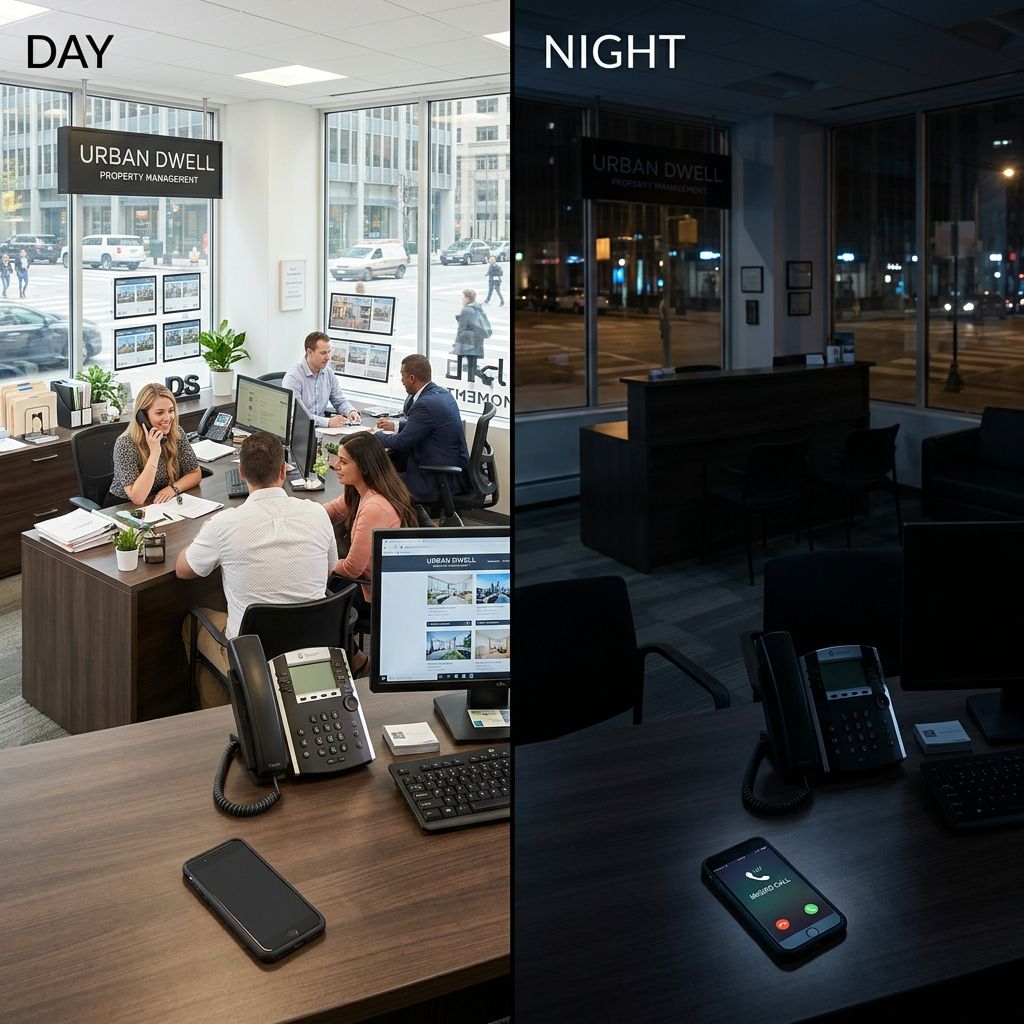
Not all calls carry equal weight. In property management, there are three categories of calls that, when missed, create the most direct and measurable damage.
Treat any number without a nearby source or stated method as a planning assumption, then replace it with your own records.
A property management company manages obligations that run around the clock, seven days a week. Tenants have emergencies at 11 PM. Prospective tenants call about vacancies at 7 AM on Saturday. Owners call with questions during the one window they have free -- which is often Sunday evening.
The staff that handles all of this is typically available from 9 AM to 5 PM on weekdays.
That is 40 hours of coverage across 168 hours of obligations. A 76% coverage gap.
Every hour that gap is open, something falls through it. A prospective tenant calls about a vacancy, does not reach anyone, and applies at a competing property. A maintenance emergency escalates because no one triaged it until morning. An owner calls with a concern, reaches voicemail, and starts thinking about whether to take their portfolio elsewhere.
I have audited property management companies ranging from 50 units under management to 800. The gap between their service obligations and their staffing coverage is the most consistent source of revenue loss and client churn I see in this vertical. It is also one of the most straightforwardly solvable.
The Three Calls That Cost You the Most
Not all calls carry equal weight. In property management, there are three categories of calls that, when missed, create the most direct and measurable damage.
Prospective tenant leasing inquiries. Vacancy is the central revenue problem in property management. An empty unit is a month of lost rent, plus the carrying costs of the vacancy period. Prospective tenants -- the people who can fill that vacancy -- are typically looking at multiple properties simultaneously. They call, they text, they fill out online forms. Whichever property responds first and schedules a showing fastest wins the application.
If your leasing inquiry line goes to voicemail after 5 PM or on weekends -- which is precisely when many working professionals have time to call -- you are handing those leads to competitors who have coverage.
I tracked a property management company managing 240 units across twelve properties. Their average vacancy period was 34 days. A competitor in the same market -- managing similar properties at similar price points -- averaged 19 days. The difference was entirely attributable to response time on leasing inquiries. The competitor had AI-powered 24/7 leasing coverage. My client had an office that closed at 5 PM.
The 15-day vacancy difference, multiplied across their average unit count and average monthly rent of $1,450, represented roughly $65,000 per year in lost rental income to their owners -- and a direct impact on their own management fee revenue.
Maintenance emergency calls. Tenant maintenance emergencies are the moment of truth for any property management company. When a tenant has a burst pipe, a furnace failure in winter, or a security issue, their experience of how quickly and effectively the management company responds determines whether they renew their lease and whether they give a positive review.
A maintenance emergency call that hits voicemail at 9 PM and is not addressed until the next morning is not just a service failure. It is a lease renewal risk, a liability risk, and a review risk -- simultaneously.
The triage function for maintenance calls is exactly what AI handles well. The system can determine from the caller's description whether the situation requires immediate contractor dispatch, whether it can safely wait until morning, or whether it is a tenant-resolvable issue (like a tripped circuit breaker). That triage, done well, protects properties from further damage and protects tenants from extended emergencies.
Owner calls and concerns. Property owners are your clients. They are paying you to manage their asset and keep them informed. When an owner calls with a question or a concern and reaches voicemail -- particularly in the evening or on a weekend -- the experience communicates that the company is unavailable when owners need them.
Owner churn is the most expensive loss in property management, because losing a portfolio means losing all the units in that portfolio, not just one. A company managing a portfolio of 80 units for a single owner that loses that owner over a service responsiveness issue loses its largest single revenue relationship.
What Actually Happens When Calls Go to Voicemail
I want to describe the specific cascade that follows a missed call at a property management company, because the cost is often invisible to the people managing the business.
A prospective tenant calls at 6:30 PM on a Friday about a two-bedroom unit. Your office is closed. The caller gets voicemail. They do not leave a message. Instead, they apply at the property down the street that has a chat widget on their website and a leasing agent who answers the phone.
Your unit is shown on Monday. The prospective tenant who calls Monday has fewer options than the one who called Friday -- the best applicants move quickly. You end up choosing from a smaller pool and the unit takes another two weeks to fill.
Meanwhile, a tenant in a different property called at 8 PM Thursday about a water heater that stopped working. It hit voicemail. They texted their friend for a space heater and spent a cold night before your maintenance coordinator saw the message Friday morning. By that point, the tenant is furious. They are actively considering whether to renew their lease. They post a one-star Google review mentioning that nobody answered their emergency call.
That review stays on your Google profile. The next property owner who searches for a property management company in your area reads it.
These are not hypothetical scenarios. They are patterns that appear, with minor variation, in almost every property management audit I conduct.
The Specific Calls AI Handles in Property Management
Let me be precise about what a purpose-configured AI system actually does in this context, because the implementation is vertical-specific.
Leasing inquiries: The AI answers, confirms the property address the caller is interested in, provides current availability and rental price, describes the unit's amenities, and either schedules a showing directly in the calendar or collects the prospective tenant's information for a leasing agent follow-up. The caller gets an immediate, professional response and a confirmed next step.
Maintenance request intake: The AI asks the tenant to describe the issue, asks for the unit address and their contact information, and classifies the request by urgency. For emergencies -- water damage, no heat in winter, security issues -- it immediately notifies the on-call maintenance contact. For non-emergency requests, it logs the ticket into the property management software and confirms a response window for the tenant.
Rent and payment questions: A tenant calling to ask about their balance, their payment options, or their late fee can often be handled entirely by AI, which has access to the relevant payment portal information and standard policy answers. This category represents a significant portion of routine call volume that does not require human judgment.
Owner inquiry routing: An owner calling about a property performance question can be identified, greeted by name if the system integrates with the CRM, provided with basic account information, and routed to the appropriate property manager for a scheduled callback, with the inquiry logged so the manager is prepared.
None of these require hiring additional staff. They require a system.
The Owner Retention Problem This Creates
I want to spend time on owner retention because it is, in my experience, the most underappreciated financial risk in property management.
The average property management company in the United States manages between 50 and 300 units, spread across multiple owners. Management fees typically range from 8% to 12% of collected rent. At $1,400 per unit per month and 10% management fee, each unit generates roughly $1,680 per year in management fee revenue.
A single owner with a portfolio of 20 units is worth approximately $33,600 per year in management fees. If that owner calls on a Saturday evening because they saw something on the news about new landlord legislation and wants to know if it affects their properties -- and gets voicemail -- the experience registers as "they are not available when I need them."
Three or four experiences like this, spread over six months, and that owner starts taking meetings with other property management companies. Not because you did a bad job managing their properties. Because you felt inaccessible.
The AI system does not solve this by giving the owner a substantive answer about landlord legislation at 7 PM on Saturday. It solves it by answering, acknowledging the owner's concern, confirming that a property manager will follow up first thing Monday with the relevant information, and logging the inquiry so the manager can prepare.
The owner feels heard. The relationship does not erode. The $33,600 per year stays.
What the Best Property Management Companies Are Already Doing
The companies that have figured this out first are almost universally the ones growing their portfolios while others in their market are stagnant or declining.
Their vacancy periods are shorter. Their owner churn rates are lower. Their online reviews are better -- because tenant experiences, particularly in maintenance emergencies, are dramatically better. Their management teams are less stressed, because they are not fielding the volume of "why didn't anyone answer when I called last night" calls from both tenants and owners.
They are not larger companies. They are not spending more on staff. They are running more intelligently on the hours they have, because the AI covers the hours they do not.
This is not a futuristic scenario. This is happening in property management markets right now. The companies investing in this infrastructure in the next twelve months are going to look like the market leaders in their geography in two to three years, simply because they will have dramatically better service coverage data, cleaner CRMs, and more reliable owner and tenant communication histories.
The companies waiting are going to find that the narrative around their responsiveness -- their online reviews, their reputation, their owner referrals -- is being written by the gap.
What the Transition Actually Looks Like
I want to address the implementation reality, because property management companies often have concerns about change management with existing tenants and owners.
The first question is usually: "Will our tenants be upset that they are talking to AI when they call about a maintenance issue?"
The experience data says no, provided the AI is configured correctly. Tenants calling about maintenance at 10 PM care about two things: that their call was answered and that they know when help is coming. An AI system that takes their call immediately, collects the issue details, confirms the urgency classification, and tells them "your request has been logged and a technician will contact you within X hours" delivers both of those things. The tenant does not feel unheard. They feel handled.
Tenants who previously called and got voicemail -- and then waited until the next day for anyone to acknowledge their call -- are, without exception, relieved when they experience the new system.
The owner communication is worth being proactive about. A brief message to owners announcing the new intake coverage, explaining what it covers and why it exists, and confirming that complex owner concerns will always be handled by a human manager is typically received positively. Owners want their properties managed professionally. A property management company that invests in 24/7 intake coverage signals exactly that.
The Records That Prove the Property Management Gap
Start with after-hours call logs, CRM notes, maintenance request timestamps, leasing inquiry response time, owner complaint notes, and negative review themes. If those records show unanswered tenant issues or slow leasing follow-up, the fix is not just more advertising. It is a front-door system that answers, triages, routes, documents, and escalates when the office is closed.
The loss estimate is basic business math, not a magic claim.
Revenue-leak examples on this site are built from visible operating inputs: inquiry volume, missed-call or slow-response rate, booking rate, average job or client value, repeat value, and follow-up recovery. The fastest way to make the number real is to run the diagnostic for your closest business type, then compare it against your own call log, CRM, booking calendar, form timestamps, and review activity.
Connect one customer path before adding more disconnected tools.
The first useful system owns a defined journey from customer action to team handoff and follow-up.

Vikram Roy is the founder of The Quiet Protocol, a Toronto-based systems firm serving service businesses across the Greater Toronto Area, Canada, and the United States. He works directly with professional firms, home service companies, dental practices, clinics, and local businesses to connect websites, customer intake, booking, reviews, follow-up, and practical AI into a clearer digital front door. All content is written from Toronto, Ontario. See the editorial method →
See where a Smart Website, software plan, AI intake path, or Custom Customer System fits before committing to a scope.
See how the capability in this article fits into a complete customer journey.
Property ManagementSee the same decision through the language, buyer behavior, and operating reality of this industry.
Client Results & ProofInspect the starting condition, installation, measurement window, and outcome behind real client work.

Your Leads Call After 5PM: What Happens to Them If You Are Not There
The highest-intent service calls arrive after business hours. Here is exactly what happens to those leads, why most are never recovered, and what to do about it.

What Is a Revenue Leak Diagnostic? The 15-Minute Diagnostic That Reveals Your Service Business Revenue Gap
A Revenue Leak Diagnostic is a structured 15-minute diagnostic that calculates the exact dollar value of revenue a service business is losing at the point of first contact, before a single dollar of marketing is changed.

AI Business Operating System: What the Label Should Mean Before You Buy
A plain-language buyer guide to the category label, the operating path underneath it, and the questions that separate useful systems from inflated software claims.