A · Structured public-site evidence
Observed and counted
The benchmark records what was visibly present across 118 eligible public websites under a calibrated rubric. Percentages in this report come only from this evidence stream.
The Quiet Protocol · 2026 field and website study
Research and analysis by Vikram Roy · Founder & Chief Architect
What 118 public websites and more than 100 firsthand conversations with CPA and accounting-firm owners suggest about where the digital front door really ends.
The website evidence and practitioner observations are separate evidence streams. Together, they point to an opportunity to move administrative work out of professional time without removing the accountant from decisions that require judgment.
Why we started looking
Many accounting firms look professionally established from the outside. They name services, show credentials, introduce partners, and provide a way to get in touch. The visible journey can still end with three broad instructions: call us, complete a general form, or book a consultation.
That is not evidence of how any firm operates internally. It is a public design pattern. But when little qualification, routing, intake, or expectation-setting happens before the meeting, the professional may be pulled into the process before the administrative work is complete. That is an interpretation worth testing, not a causal fact established by the website crawl.
Two evidence streams
A · Structured public-site evidence
The benchmark records what was visibly present across 118 eligible public websites under a calibrated rubric. Percentages in this report come only from this evidence stream.
B · Practitioner field observations
The founder’s consulting and commercial field observations across more than 100 conversations supply recurring operating patterns. This was not a structured interview sample. The observations were not formally coded for prevalence and are not results from the 118-site benchmark.
What 118 public websites showed
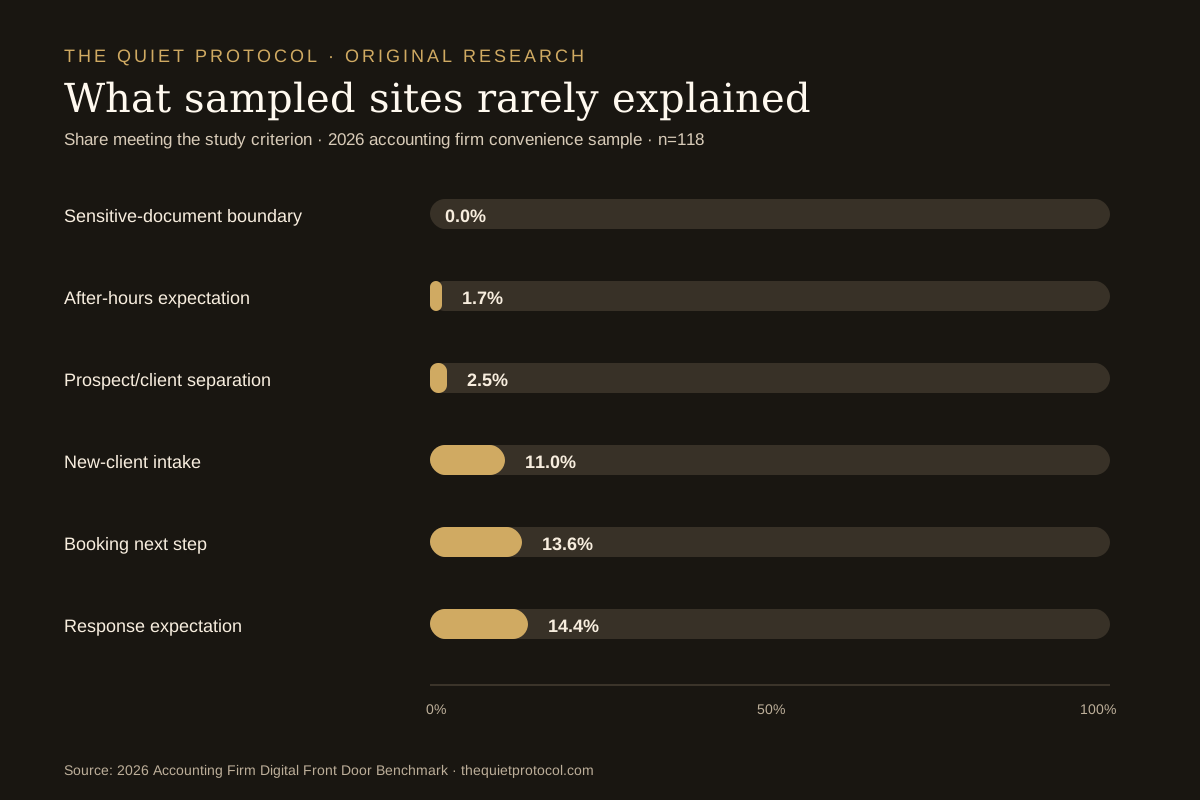
Contactable is not the same as guided. The sample was strongest at exposing a place to make contact. The path became thinner as the visitor moved toward qualification, intake, response, and safe handoff.
The meeting gap
82 of 118
sites exposed a visible consultation path without explaining the next step. The meeting was easy to request; the qualification path before it was usually less explicit.
102 of 118. Most sampled sites provided a recognizable place to begin contact.
Study definition: Navigation or page content exposes a dedicated contact route. Wilson 95% interval 79.1% to 91.5%.
96 of 118. Written contact was more commonly visible than a public phone route.
Study definition: A visible email or contact form destination is present; the form is observed but never submitted. Wilson 95% interval 73.4% to 87.4%.
98 of 118. A consultation-oriented next step was usually visible in the sample.
Study definition: A visible consultation, appointment, or scheduling path exists; it is not activated. Wilson 95% interval 75.3% to 88.8%.
20 of 118. A visitor often had to infer whether a contact route was intended for new clients.
Study definition: A visible label or instruction identifies a route for prospective or new clients. Wilson 95% interval 11.2% to 24.7%.
16 of 118. The presence of a booking path did not usually explain the experience that followed.
Study definition: The page indicates what the meeting is for, who it is with, timing, or what follows. Wilson 95% interval 8.5% to 20.9%.
13 of 118. Visitors may have had limited visibility into how the firm starts a new relationship.
Study definition: A public route or explanation identifies how a new client begins intake. Wilson 95% interval 6.6% to 17.9%.
Descriptive maturity view
The stages synthesize seven directly observed signals. They are not firm-quality scores, operating assessments, or national estimates.
What we heard behind the website
Practitioner field observations. Recurring patterns, not prevalence estimates.
In consulting and commercial field observations across more than 100 conversations with CPA and accounting-firm owners, we repeatedly heard that professional time was being used for work that could have happened before the owner entered the process. This was not a structured interview sample. The observations were not formally coded and do not establish how common a pattern is across the profession.
Owners described answering routine questions, collecting background, checking fit, chasing follow-up, and coordinating next steps themselves.
A free or unpaid consultation can become the first place the firm establishes fit, urgency, scope, and readiness. Professional time is consumed before the basic administrative work is complete.
When information arrives through general calls, forms, and email, the owner or a trusted staff member often has to reconstruct context and remember what should happen next.
A founder-name identity and founder-held relationships can strengthen trust while also making delegation, time away, and growth beyond personal capacity harder.
Qualitative homepage reading
I reviewed the existing 20-site calibration set manually and with model assistance. It surfaced recurring homepage patterns: broad tax, accounting, and advisory service lists; founder-name-led identities; general promises of personal or professional service; and invitations to call, contact, or request a free consultation without much fit guidance.
Representative wording patterns included “welcome to our website,” “personal and professional service,” “professional, accurate and confidential,” and “free consultation.” These phrases are anonymized and illustrative. The review was not reliable enough to support a prevalence percentage.
Professional credibility and decision-stage proof should not be treated as the same thing. A named partner or CPA designation establishes accountability. It does not, by itself, explain the ideal client, show a specific outcome, demonstrate recent expertise, or help a prospect decide whether this firm is the right fit.
The owner-dependence problem
A more polished homepage may improve confidence while leaving the operating path unchanged. If every inquiry still becomes a general message, every consultation still begins from zero, and every follow-up still depends on memory, the owner remains the coordination layer.
The combined evidence does not prove that a shallow public path causes owner dependence. It supports a narrower conclusion: public journeys with little qualification, routing, intake, or expectation-setting are consistent with the administrative patterns owners repeatedly described.
That relationship is the commercial opportunity. Improve the experience outside and the operating handoff behind it at the same time.
What a real digital front door should do
The goal is not to remove the accountant. It is to protect professional judgment from unnecessary administrative work.
Explain who the firm is for, which problems it handles, and when another route is more appropriate.
Ask the administrative questions before professional judgment is required.
Separate prospects, current clients, service needs, document requests, and urgent exceptions.
Explain response timing, after-hours handling, safe document boundaries, and what happens next.
Match the person, meeting type, preparation, and timing to the work already established.
Confirm, remind, request missing information, and hand off without relying on memory.
Benchmark percentages come only from the frozen 118-site public sample. The practitioner section reports founder-provided recurring observations without percentages. The relationship between them is editorial interpretation, not causal proof.
The benchmark remains a convenience sample and is not nationally representative. No firm names or firm-level results are published. Mobile experience was not scored.
Selected data and downloads
All 24 measures remain in the aggregate downloads and technical methodology. Practitioner observations are excluded from the dataset.
Cite this research
The Quiet Protocol. “The Owner Is Still the Operating System: The 2026 Accounting Firm Digital Front Door White Paper.” September 2026. https://www.thequietprotocol.com/benchmarks/accounting-firm-digital-front-door-2026
Attribute quantitative findings to the 118-site convenience sample. Describe the operating observations as founder-reported recurring patterns from more than 100 CPA and accounting-firm owner conversations.
Continue the accounting research path